Comment Améliorer l'Apprentissage Moteur : Effets des Stratégies de Focalisation Attentionnelle sur la Performance des Adolescents
DOI :
https://doi.org/10.7346/-fei-XXIV-01-26_14Mots-clés :
Focalisation Attentionnelle, Apprentissage Moteur, Stratégies d'Instruction, Résultats Cognitifs et de Performance, AdolescentsRésumé
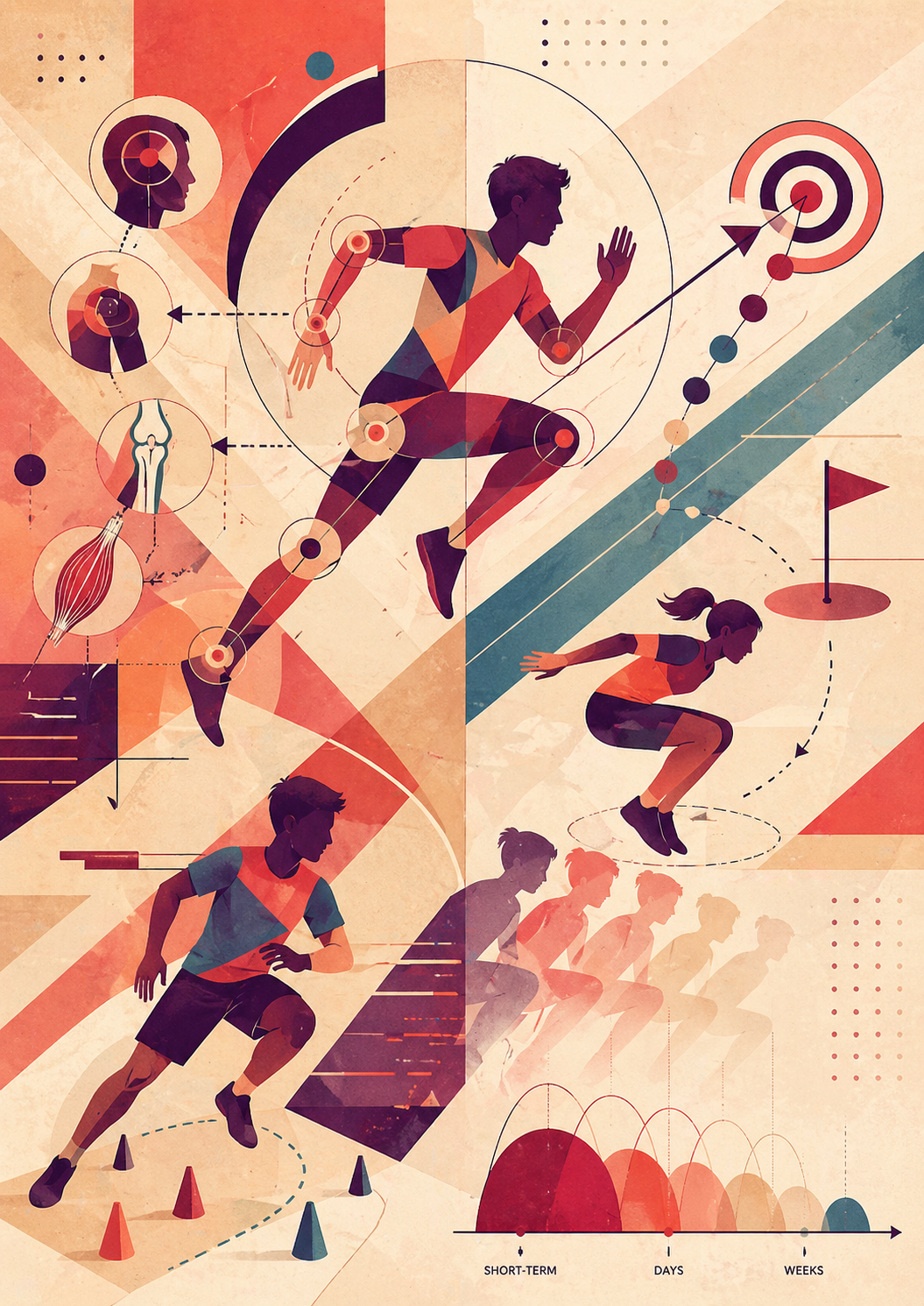
L'efficacité des stratégies d'instruction dans l'entraînement sportif des jeunes constitue un thème central en psychologie du sport, car les modalités d'enseignement peuvent influencer à la fois les paramètres cognitifs et les résultats de performance. Cette étude visait à examiner les effets de différentes stratégies de focalisation attentionnelle (focalisation interne vs focalisation externe) sur les résultats de performance neuromusculaire et sur leur rétention à court et moyen terme chez des athlètes adolescents. Deux stratégies spécifiques ont été utilisées : l'une fondée sur une focalisation externe, orientant les processus cognitifs des jeunes athlètes vers les effets visibles du mouvement, et l'autre fondée sur une focalisation interne, centrant l'attention sur les mécanismes biomécaniques sous-jacents au mouvement manifeste. Les protocoles d'exercice adoptés s'appuient sur la méthodologie de mouvement Sincrony, garantissant une exécution coordonnée conforme aux principes du contrôle moteur. Un échantillon de 196 adolescents (15,25 ± 0,75 ans) a été réparti en deux groupes, tous deux s'entraînant pendant huit semaines avec des exercices physiques identiques, mais avec des consignes attentionnelles différentes. Après une période de familiarisation, tous les participants ont été évalués avant et après l'intervention, ainsi que lors d'un suivi quatre semaines après la fin du protocole. Les évaluations ont été réalisées à l'aide de tests de saut sur plateforme de force et d'un test de force maximale des membres supérieurs au moyen de dynamomètres électroniques. Les résultats ont mis en évidence des améliorations significatives de la hauteur de saut, de la puissance de saut et de la force maximale (p < 0,001) dans les deux groupes. Toutefois, le groupe à focalisation interne a présenté une plus grande stabilité dans le temps, en particulier pour la force maximale, tandis que le groupe à focalisation externe a obtenu des améliorations plus immédiates des performances explosives, avec une diminution des performances aux tests de saut lors du suivi similaire entre les deux groupes.
Références
Bahr, R. (2003). Risk factors for sports injuries: A methodological approach. British Journal of Sports Medicine, 37(5), 384–392. https://doi.org/10.1136/bjsm.37.5.384
Batista, A., Gomes, T. N., Rui, G., & Avila-Carvalho, L. (2018). Training intensity of group in rhythmic gymnastics. Science, Movement and Health, 18(1), 17–24. Retrieved January 6, 2026, from https://www.analefefs.ro/anale-fefs/2018/i1/pe-autori/BATISTA%20Amanda.pdf
Bobbert, M. F., & Van Soest, A. J. (1994). Effects of muscle strengthening on vertical jump height: A simulation study. Journal of Applied Biomechanics, 28(1), 1–9. Retrieved January 6, 2026, from https://journals.lww.com/acsm-msse/abstract/1994/08000/effects_of_muscle_strengthening_on_vertical_jump.13.aspx
Bortoli, L., & Robazza, C. (2016). Teaching: The instruction of techniques. In C. Mantovani (Ed.). Teaching to train: Methodology of sports instruction (pp. 141–173). SDS Editions.
Bosco, C., & Komi, P. V. (1979). Potentiation of the mechanical behavior of the human skeletal muscle through prestretching. Acta Physiologica Scandinavica, 106(4), 467–472. https://doi.org/10.1111/j.1748-1716.1979.tb06427.x
Chen, C. S. (2005). Biomechanical study on a new training machine and method for power and strength. Journal of Mechanics in Medicine and Biology, 5(2), 259–272. https://doi.org/10.1142/S0219519405001448
Cormie, P., McCaulley, G. O., & McBride, J. M. (2007). Power versus strength-power jump squat training: Influence on the load-power relationship. Medicine & Science in Sports & Exercise, 39(6), 996–1003. https://doi.org/10.1097/MSS.0b013e3180408e0c
Cronin, J. B., McNair, P. J., & Marshall, R. N. (2000). The role of maximal strength and load on initial power production. Medicine & Science in Sports & Exercise, 32(10), 1763–1769. https://doi.org/10.1097/00005768-200010000-00016
De Bernardi, F. (2008). Sincrony: Educare al Movimento. Red!
Ducharme, S. W., Wu, W. F., Lim, K., Porter, J. M., & Geraldo, F. (2016). Standing long jump performance with an external focus of attention is improved as a result of a more effective projection angle. Journal of Strength and Conditioning Research, 30(1), 276–281. https://doi.org/10.1519/JSC.0000000000001050
Fogliata, A., Tardini, S., & Ambretti, A. (2024). Innovative didactics and ICT in the Sports Science Degree: An integrated approach for university teacher education. Italian Journal of Educational Technology, 32(3), 1345. https://doi.org/10.17471/2499-4324/1345
Hunt, C., Paez, A., & Folmar, E. (2017). The impact of attentional focus on the treatment of musculoskeletal and movement disorders. International Journal of Sports Physical Therapy, 12(6), 901–908. https://doi.org/10.26603/IJSPT20170901
Juntara, P. E. (2019). Latihan kekuatan dengan beban bebas metode circuit training dan plyometric. Altius: Jurnal Ilmu Olahraga dan Kesehatan, 8(2), 89–98. https://doi.org/10.36706/ALTIUS.V8I2.8705
Lin, C. Y., Casey, E., Herman, D. C., Katz, N., & Tenforde, A. S. (2018). Sex differences in common sports injuries. PM&R, 10(10), 1073–1082. https://doi.org/10.1016/j.pmrj.2018.03.008
Malina, R. M., Eisenmann, J. C., Cumming, S. P., Ribeiro, B., & Aroso, J. (2004). Maturity-associated variation in the growth and functional capacities of youth football (soccer) players 13-15 years. Eur J Appl Physiol, 91(5-6), 555–562. https://doi.org/10.1007/s00421-003-0995-z
Marchant, D. C. (2011). Attentional focusing instructions and force production. Frontiers in Psychology, 1, 210. https://doi.org/10.3389/fpsyg.2010.00210
Marchant, D. C., Greig, M., & Scott, C. (2009). Attentional focusing instructions influence force production and muscular activity during isokinetic elbow flexions. Journal of Strength and Conditioning Research, 23(8), 2358–2366. https://doi.org/10.1519/JSC.0b013e3181b8d1e5
McNevin, N. H., & Wulf, G. (2002). Attentional focus on suprapostural tasks affects postural control. Human Movement Science, 22(6), 621–633. https://doi.org/10.1016/S0167-9457(02)00095-7
Pan, Y., Dikker, S., Zhu, Y., Yang, C., Hu, Y., & Goldstein, P. (2022). Instructor-learner body coupling reflects instruction and learning. npj Science of Learning, 7(1), 15. https://doi.org/10.1038/s41539-022-00131-0
Pestano, R. D. (2021). Sports-teachers’ coaching style, behavior, competency and student-athletes performance in sports. Kinestetik: Jurnal Ilmiah Pendidikan Jasmani, 5(1), 9–16. https://doi.org/10.33369/JK.V5I1.14619
Platvoet, S., Elferink-Gemser, M., & Visscher, C. (2018). For future athletic success work attitude capacity and sport learning capacity in experts’ perceptions most important in 6–8 year olds. Psychology, 9(14), 2885–2895. https://doi.org/10.4236/PSYCH.2018.914167
Porter, J. M., Nolan, R. P., Ostrowski, E. J., & Wulf, G. (2010). Directing attention externally enhances agility performance: A qualitative and quantitative analysis of the efficacy of attentional focus instructions. Journal of Strength and Conditioning Research, 24(7), 1746–1750. https://doi.org/10.1519/JSC.0b013e3181dc48ac
Schmidt, R. A., & Lee, T. D. (2011). Motor control and learning: A behavioral emphasis. Human Kinetics. 5th ed.
Schmidt, R. A., & Lee, T. D. (2011). Motor learning and performance: From principles to application. Human Kinetics. 5th ed.
Schoenfeld, B. J., Grgic, J., & Krieger, J. (2019). How many times per week should a muscle be trained to maximize muscle hypertrophy? A systematic review and meta-analysis of studies examining the effects of resistance training frequency. Journal of Sports Sciences, 37(11), 1286–1295. https://doi.org/10.1080/02640414.2018.1555906
Sheehan, K. J., Guerra, S., Ayis, S., Goubar, A., Foster, N. E., Martin, F. C., Godfrey, E., Cameron, I. D., Gregson, C. L., Walsh, N. E., Ferguson Montague, A., Edwards, R., Adams, J., Jones, G. D., Gibson, J., Sackley, C., & Whitney, J. (2024). Structured tailored rehabilitation after hip fragility fracture: The ‘Stratify’ feasibility and pilot randomised controlled trial protocol. PLOS ONE, 19(12), e0306870. https://doi.org/10.1371/journal.pone.0306870
Smith, A., & Biddle, S. (2008). Youth physical activity and sedentary behavior: Challenges and solutions. Human Kinetics.
Tolentino, A. J. P. (2020). Coaching competence of public school teachers: An input to student-athlete performance. IJAR, 8(10), 1092–1102. https://doi.org/10.21474/IJAR01/11938
Trapero-Asenjo, S., Fernández-Guinea, S., Guillot, A., & colleagues (2025). Muscle relaxation enhances motor imagery capacity in people with anxiety: A randomized clinical trial. PLOS ONE, 20(1), e0316723. https://doi.org/10.1371/journal.pone.0316723
Weakley, J. J. S., Till, K., Darrall-Jones, J., Roe, G. A. B., Phibbs, P. J., Read, D. B., & Jones, B. L. (2017). The influence of resistance training experience on the between-day reliability of commonly used strength measures in male youth athletes. Journal of Strength and Conditioning Research, 31(7), 2005–2010. https://doi.org/10.1519/JSC.0000000000001883
Wulf, G. (2013). Attentional focus and motor learning: A review of 15 years. International Review of Sport and Exercise Psychology, 6(1), 77–104. https://doi.org/10.1080/1750984X.2012.723728
Wulf, G., & Lewthwaite, R. (2016). Optimizing performance through intrinsic motivation and attention for learning: The OPTIMAL theory of motor learning. Psychonomic Bulletin & Review, 23(5), 1382–1414. https://doi.org/10.3758/s13423-015-0999-9
Yao, Z. F., Yang, M. H., & Hsieh, S. (2020). Brain structural-behavioral correlates underlying Grooved Pegboard Test performance across lifespan. Journal of Motor Behavior, 53, 1–12. https://doi.org/10.1080/00222895.2020.1787320
Téléchargements
Publié-e
Comment citer
Numéro
Rubrique
Catégories
Licence
(c) Tous droits réservés Arianna Fogliata, Gianluca Gravino, Davide Di Palma 2026

Cette œuvre est sous licence Creative Commons Attribution 4.0 International.
Formazione & insegnamento est distribué sous licence Attribution 4.0 International (CC BY 4.0).
Pour plus de détails, veuillez vous référer à notre Politique de dépôt et d’archivage ainsi qu’à nos Conditions de droits d’auteur et de licences.