
Cómo Mejorar el Aprendizaje Motor: Efectos de las Estrategias de Focalización Atencional en el Rendimiento de los Adolescentes
DOI:
https://doi.org/10.7346/-fei-XXIV-01-26_14Palabras clave:
Focalización Atencional, Aprendizaje Motor, Estrategias de Instrucción, Resultados Cognitivos y de Rendimiento, AdolescentesResumen
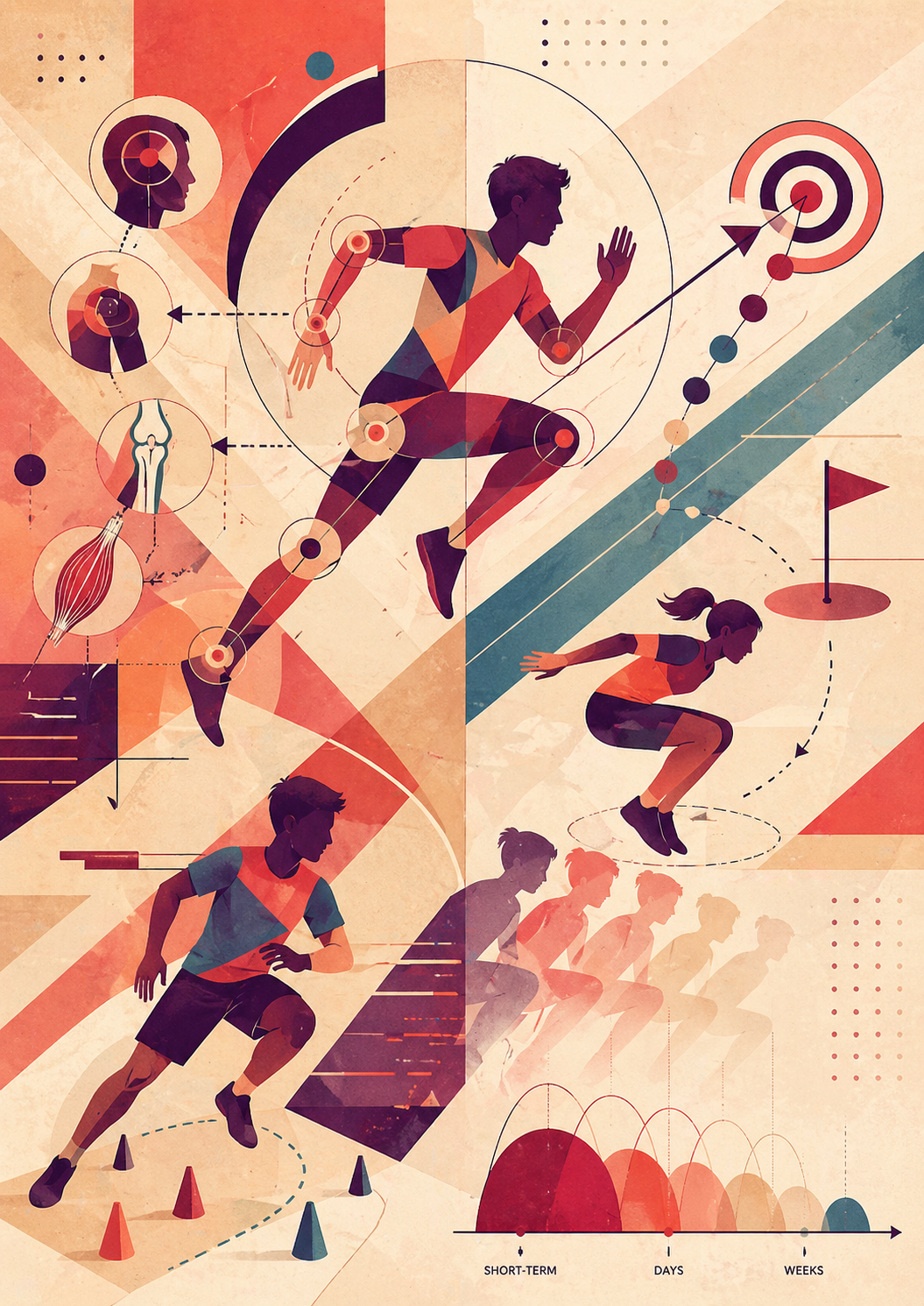
La eficacia de las estrategias de instrucción en el entrenamiento deportivo juvenil constituye un tema central en la psicología del deporte, ya que las modalidades de enseñanza pueden influir tanto en los parámetros cognitivos como en los resultados de rendimiento. Este estudio tuvo como objetivo investigar los efectos de diferentes estrategias de focalización atencional (foco interno vs foco externo) sobre los resultados del rendimiento neuromuscular y su retención a corto y medio plazo en atletas adolescentes. Se utilizaron dos estrategias específicas: una basada en el foco externo, que orienta los procesos cognitivos de los jóvenes atletas hacia los efectos visibles del movimiento, y otra basada en el foco interno, que centra la atención en los mecanismos biomecánicos subyacentes al movimiento manifiesto. Los protocolos de ejercicio adoptados se basan en la metodología de movimiento Sincrony, garantizando una ejecución coordinada conforme a los principios del control motor. Una muestra de 196 adolescentes (15,25 ± 0,75 años) se dividió en dos grupos, ambos trabajando durante ocho semanas con ejercicios físicos idénticos pero con instrucciones atencionales diferentes. Tras un periodo de familiarización, todos los participantes fueron evaluados antes y después de la intervención, así como en un seguimiento a las cuatro semanas de la finalización del protocolo. Las evaluaciones se realizaron mediante pruebas de salto en plataforma de fuerza y una prueba de fuerza máxima de los miembros superiores con dinamómetros electrónicos. Los resultados mostraron mejoras significativas en la altura de salto, la potencia de salto y la fuerza máxima (p < 0,001) en ambos grupos. Sin embargo, el grupo de foco interno presentó una mayor estabilidad a lo largo del tiempo, especialmente en la fuerza máxima, mientras que el grupo de foco externo logró mejoras más inmediatas en el rendimiento explosivo, con un descenso del rendimiento en las pruebas de salto en el seguimiento similar entre ambos grupos.
Citas
Bahr, R. (2003). Risk factors for sports injuries: A methodological approach. British Journal of Sports Medicine, 37(5), 384–392. https://doi.org/10.1136/bjsm.37.5.384
Batista, A., Gomes, T. N., Rui, G., & Avila-Carvalho, L. (2018). Training intensity of group in rhythmic gymnastics. Science, Movement and Health, 18(1), 17–24. Retrieved January 6, 2026, from https://www.analefefs.ro/anale-fefs/2018/i1/pe-autori/BATISTA%20Amanda.pdf
Bobbert, M. F., & Van Soest, A. J. (1994). Effects of muscle strengthening on vertical jump height: A simulation study. Journal of Applied Biomechanics, 28(1), 1–9. Retrieved January 6, 2026, from https://journals.lww.com/acsm-msse/abstract/1994/08000/effects_of_muscle_strengthening_on_vertical_jump.13.aspx
Bortoli, L., & Robazza, C. (2016). Teaching: The instruction of techniques. In C. Mantovani (Ed.). Teaching to train: Methodology of sports instruction (pp. 141–173). SDS Editions.
Bosco, C., & Komi, P. V. (1979). Potentiation of the mechanical behavior of the human skeletal muscle through prestretching. Acta Physiologica Scandinavica, 106(4), 467–472. https://doi.org/10.1111/j.1748-1716.1979.tb06427.x
Chen, C. S. (2005). Biomechanical study on a new training machine and method for power and strength. Journal of Mechanics in Medicine and Biology, 5(2), 259–272. https://doi.org/10.1142/S0219519405001448
Cormie, P., McCaulley, G. O., & McBride, J. M. (2007). Power versus strength-power jump squat training: Influence on the load-power relationship. Medicine & Science in Sports & Exercise, 39(6), 996–1003. https://doi.org/10.1097/MSS.0b013e3180408e0c
Cronin, J. B., McNair, P. J., & Marshall, R. N. (2000). The role of maximal strength and load on initial power production. Medicine & Science in Sports & Exercise, 32(10), 1763–1769. https://doi.org/10.1097/00005768-200010000-00016
De Bernardi, F. (2008). Sincrony: Educare al Movimento. Red!
Ducharme, S. W., Wu, W. F., Lim, K., Porter, J. M., & Geraldo, F. (2016). Standing long jump performance with an external focus of attention is improved as a result of a more effective projection angle. Journal of Strength and Conditioning Research, 30(1), 276–281. https://doi.org/10.1519/JSC.0000000000001050
Fogliata, A., Tardini, S., & Ambretti, A. (2024). Innovative didactics and ICT in the Sports Science Degree: An integrated approach for university teacher education. Italian Journal of Educational Technology, 32(3), 1345. https://doi.org/10.17471/2499-4324/1345
Hunt, C., Paez, A., & Folmar, E. (2017). The impact of attentional focus on the treatment of musculoskeletal and movement disorders. International Journal of Sports Physical Therapy, 12(6), 901–908. https://doi.org/10.26603/IJSPT20170901
Juntara, P. E. (2019). Latihan kekuatan dengan beban bebas metode circuit training dan plyometric. Altius: Jurnal Ilmu Olahraga dan Kesehatan, 8(2), 89–98. https://doi.org/10.36706/ALTIUS.V8I2.8705
Lin, C. Y., Casey, E., Herman, D. C., Katz, N., & Tenforde, A. S. (2018). Sex differences in common sports injuries. PM&R, 10(10), 1073–1082. https://doi.org/10.1016/j.pmrj.2018.03.008
Malina, R. M., Eisenmann, J. C., Cumming, S. P., Ribeiro, B., & Aroso, J. (2004). Maturity-associated variation in the growth and functional capacities of youth football (soccer) players 13-15 years. Eur J Appl Physiol, 91(5-6), 555–562. https://doi.org/10.1007/s00421-003-0995-z
Marchant, D. C. (2011). Attentional focusing instructions and force production. Frontiers in Psychology, 1, 210. https://doi.org/10.3389/fpsyg.2010.00210
Marchant, D. C., Greig, M., & Scott, C. (2009). Attentional focusing instructions influence force production and muscular activity during isokinetic elbow flexions. Journal of Strength and Conditioning Research, 23(8), 2358–2366. https://doi.org/10.1519/JSC.0b013e3181b8d1e5
McNevin, N. H., & Wulf, G. (2002). Attentional focus on suprapostural tasks affects postural control. Human Movement Science, 22(6), 621–633. https://doi.org/10.1016/S0167-9457(02)00095-7
Pan, Y., Dikker, S., Zhu, Y., Yang, C., Hu, Y., & Goldstein, P. (2022). Instructor-learner body coupling reflects instruction and learning. npj Science of Learning, 7(1), 15. https://doi.org/10.1038/s41539-022-00131-0
Pestano, R. D. (2021). Sports-teachers’ coaching style, behavior, competency and student-athletes performance in sports. Kinestetik: Jurnal Ilmiah Pendidikan Jasmani, 5(1), 9–16. https://doi.org/10.33369/JK.V5I1.14619
Platvoet, S., Elferink-Gemser, M., & Visscher, C. (2018). For future athletic success work attitude capacity and sport learning capacity in experts’ perceptions most important in 6–8 year olds. Psychology, 9(14), 2885–2895. https://doi.org/10.4236/PSYCH.2018.914167
Porter, J. M., Nolan, R. P., Ostrowski, E. J., & Wulf, G. (2010). Directing attention externally enhances agility performance: A qualitative and quantitative analysis of the efficacy of attentional focus instructions. Journal of Strength and Conditioning Research, 24(7), 1746–1750. https://doi.org/10.1519/JSC.0b013e3181dc48ac
Schmidt, R. A., & Lee, T. D. (2011). Motor control and learning: A behavioral emphasis. Human Kinetics. 5th ed.
Schmidt, R. A., & Lee, T. D. (2011). Motor learning and performance: From principles to application. Human Kinetics. 5th ed.
Schoenfeld, B. J., Grgic, J., & Krieger, J. (2019). How many times per week should a muscle be trained to maximize muscle hypertrophy? A systematic review and meta-analysis of studies examining the effects of resistance training frequency. Journal of Sports Sciences, 37(11), 1286–1295. https://doi.org/10.1080/02640414.2018.1555906
Sheehan, K. J., Guerra, S., Ayis, S., Goubar, A., Foster, N. E., Martin, F. C., Godfrey, E., Cameron, I. D., Gregson, C. L., Walsh, N. E., Ferguson Montague, A., Edwards, R., Adams, J., Jones, G. D., Gibson, J., Sackley, C., & Whitney, J. (2024). Structured tailored rehabilitation after hip fragility fracture: The ‘Stratify’ feasibility and pilot randomised controlled trial protocol. PLOS ONE, 19(12), e0306870. https://doi.org/10.1371/journal.pone.0306870
Smith, A., & Biddle, S. (2008). Youth physical activity and sedentary behavior: Challenges and solutions. Human Kinetics.
Tolentino, A. J. P. (2020). Coaching competence of public school teachers: An input to student-athlete performance. IJAR, 8(10), 1092–1102. https://doi.org/10.21474/IJAR01/11938
Trapero-Asenjo, S., Fernández-Guinea, S., Guillot, A., & colleagues (2025). Muscle relaxation enhances motor imagery capacity in people with anxiety: A randomized clinical trial. PLOS ONE, 20(1), e0316723. https://doi.org/10.1371/journal.pone.0316723
Weakley, J. J. S., Till, K., Darrall-Jones, J., Roe, G. A. B., Phibbs, P. J., Read, D. B., & Jones, B. L. (2017). The influence of resistance training experience on the between-day reliability of commonly used strength measures in male youth athletes. Journal of Strength and Conditioning Research, 31(7), 2005–2010. https://doi.org/10.1519/JSC.0000000000001883
Wulf, G. (2013). Attentional focus and motor learning: A review of 15 years. International Review of Sport and Exercise Psychology, 6(1), 77–104. https://doi.org/10.1080/1750984X.2012.723728
Wulf, G., & Lewthwaite, R. (2016). Optimizing performance through intrinsic motivation and attention for learning: The OPTIMAL theory of motor learning. Psychonomic Bulletin & Review, 23(5), 1382–1414. https://doi.org/10.3758/s13423-015-0999-9
Yao, Z. F., Yang, M. H., & Hsieh, S. (2020). Brain structural-behavioral correlates underlying Grooved Pegboard Test performance across lifespan. Journal of Motor Behavior, 53, 1–12. https://doi.org/10.1080/00222895.2020.1787320
Descargas
Publicado
Cómo citar
Número
Sección
Categorías
Licencia
Derechos de autor 2026 Arianna Fogliata, Gianluca Gravino, Davide Di Palma

Esta obra está bajo una licencia internacional Creative Commons Atribución 4.0.
Formazione & insegnamento se distribuye bajo la licencia Atribución 4.0 Internacional (CC BY 4.0).
Para más detalles, por favor refiérase a nuestra Política de Repositorio y Archivo, así como a nuestros Términos de Derechos de Autor y Licencia.