Competencies of physical education teachers in north-eastern Italy in relation to gender and length of service
DOI:
https://doi.org/10.7346/-fei-XXIV-01-26_13Keywords:
Physical education teachers, Self-evaluation, Competencies, Gender, Years of teachingAbstract
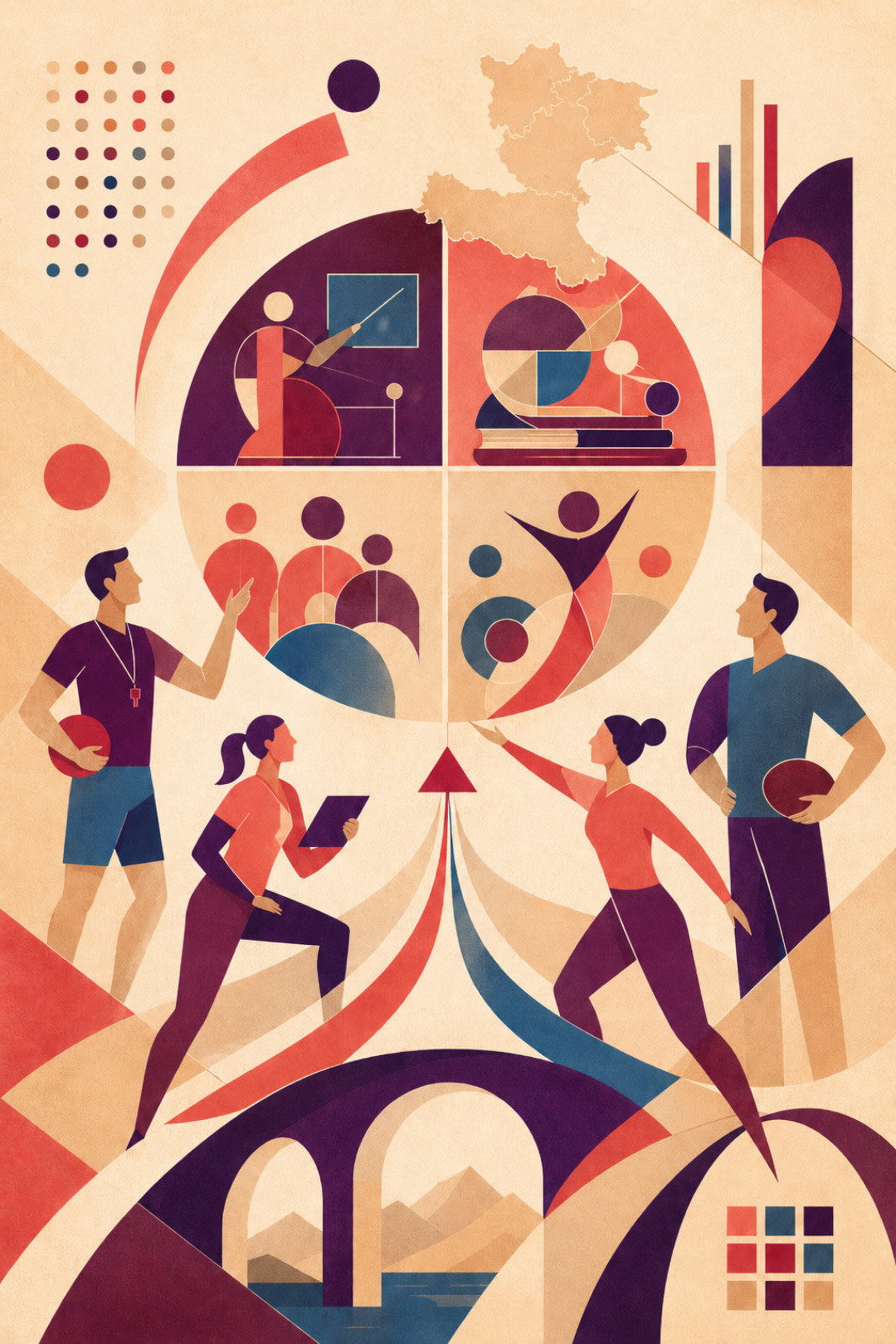
This paper examines the perceived professional competencies of physical education teachers in North-Eastern Italy, focusing on gender and years of service. A sample of 484 teachers completed a 35-item questionnaire covering four areas: teaching methods, general didactic knowledge, socio-cultural aspects, and pedagogical and motivational strategies. Findings reveal significant differences: teachers with less than 10 years of service perceive themselves as more competent in methodological skills; female teachers report greater confidence in pedagogical and motivational strategies, while male teachers consider themselves stronger in methodological, didactic, and socio-cultural dimensions. The evidence highlights the need to rethink both initial and in-service training, promoting critical, inclusive, and socially aware educational pathways able to respond to the challenges of contemporary physical education.
References
Addai-Tuffour, P., Mwisukha, A., & Nasibi, M. W. (2021). Physical Education Teachers’ Demographic Characteristics and their Pedagogical Skill Preferences and competences in Teaching Physical Education in Kumasi Metropolis, Ghana. Journal of Education, 4(5), 45–64. https://stratfordjournals.org/journals/index.php/journal-of-education/article/view/885
Appleby, K. M., & Foster, E. (2013). Gender and sport participation. In E. Roper (Ed.). Gender relations in sport (pp. 1–18). Sense.
Armour, K. M., & Yelling, M. (2007). Effective Professional Development for Physical Education Teachers: The Role of Informal, Collaborative Learning. Journal of Teaching in Physical Education, 26(2), 177–200. https://doi.org/10.1123/jtpe.26.2.177
Benetton, M., & Visentin, S. (2021). Attività fisica e sportiva inclusiva. Riflessioni pedagogiche e strategie didattiche per esperienze motorie universali. Guerini.
Burrows, L., O’Sullivan, M., Halbert, G., & Scott, E. (2020). The aims and outcomes challenge: Preparing physical education teacher educators and teachers for twenty-first century redesign imperatives and accountability requirements. In A. MacPhail, & H. Lawson (Eds.). School physical education and teacher education: Collaborative Redesign for the 21st Century (pp. 11–21). Routledge. https://doi.org/10.4324/9780429330186
Casolo, F., Coco, D., Frattini, G., Vago, P., & Casolo, A. (2019). Effective teaching competences in Physical Education. Journal of Physical Education and Sport, 19(5), 1806–1813. https://doi.org/10.7752/jpes.2019.s5265
Chalabaev, A., Sarrazin, P., Fontayne, P., & Boiché, J. (2013). The influence of sex stereotypes and gender roles on participation and performance in sport and exercise: Review and future directions. Psychology of Sport and Exercise, 14(2), 136–144. https://doi.org/10.1016/j.psychsport.2012.10.005
Cioni, L., Isidori, E., Magnanini, A., & Maulini, C. (2023). Il corpo sportivo come contenuto critico-riflessivo per la formazione degli insegnanti di educazione fisica. Annali online della Didattica e della Formazione Docente, 15(26), 102–117. https://doi.org/10.15160/2038-1034/2762
Clément-Guillotin, C., Fontayne, P., Chambaz, V., & Berthelot, G. (2011). Social environment and stereotypes of physical education: Effects on intention and behavior. Revista de Psicología del Deporte, 20(2), 527–543.
Constantinou, P., Manson, M., & Silverman, S. (2009). Female students’ perceptions of physical education. Physical Educator, 66(3), 150–160. https://eric.ed.gov/?id=EJ862181
Dudley, D., Mackenzie, E., Van Bergen, P., Cairney, J., & Barnett, L. (2022). What drives quality physical education? A systematic review and meta-analysis of learning and development effects from physical education-based interventions. Frontiers in Psychology, 13, 799330. Article number: 799330. https://doi.org/10.3389/fpsyg.2022.799330
Eurydice. (2002). Key competencies: A developing concept in general compulsory education. Eurydice. Retrieved January 7, 2026, from https://www.storiairreer.it/sites/default/files/norme/2002%2010%20EURYDICE%20key.pdf
Fullan, M. (1995). The limits and the potential of professional development. In T. R. Guskey, & M. Huberman (Eds.). Professional Development in Education: New paradigms and practices (pp. 253–267). Teachers College Press.
Guskey, T. R. (2002). Professional development and teacher change. Teachers and Teaching: Theory and Practice, 8(3), 381–391. https://doi.org/10.1080/135406002100000512
ISTAT. (2019). Stili di vita di bambini e ragazzi. Retrieved January 7, 2026, from https://www.istat.it/it/files//2019/10/Report_Stili_di_vita_minori.pdf
Koka, A., & Sildala, H. (2018). Gender differences in the relationships between perceived teachers’ controlling behaviors and amotivation in physical education. Journal of Teaching in Physical Education, 37(2), 197–208.
Kovač, M., Leskošek, B., Hadžić, V., & Jurak, G. (2013). Occupational health problems among Slovenian physical education teachers. Kinesiology, 45(1), 92–100. Retrieved January 7, 2026, from https://hrcak.srce.hr/file/153738
Kovač, M., Sloan, S., & Starc, G. (2008). Competencies in physical education teaching: Slovenian teachers’ views and future perspectives. European Physical Education Review, 14(3), 299–323. https://doi.org/10.1177/1356336X08095668
Krabonja, M. V., & Flogie, A. (2025). Vloga učečih se skupnosti v sodobnem izobraževanju. Revija Inovativna pedagogika, 1(2), 203–220. Retrieved January 7, 2026, from https://orcid.org/0000-0001-5219-9347
Lemoyne, J., Laurencelle, L., Lirette, M., & Trudeau, F. (2007). Occupational health problems and injuries among Quebec’s physical educators. Applied Ergonomics, 38(5), 625–634. https://doi.org/10.1016/j.apergo.2006.06.004
Liu, Y., & Chen, S. (2021). Physical literacy in children and adolescents: Definitions, assessments, and interventions. European Physical Education Review, 27(1), 96–112. https://doi.org/10.1177/1356336X20925502
Lynch, S., Simon, M., & Maher, A. (2023). Critical pedagogies for community building: Challenging ableism in higher education physical education in the United States. Teaching in Higher Education, (1), 195–210. https://doi.org/10.1080/13562517.2020.1789858
Manross, D., & Templeton, C. L. (1997). Expertise in teaching physical education. Journal of Physical Education, Recreation e Dance, 68(3), 29–35. https://doi.org/10.1080/07303084.1997.10605010
Maulini, C., Miatto, E., Tul, M., Kovač, M., & Migliorati, M. (2022). Working conditions and self-perception of competence of physical education teachers: A qualitative investigation. Giornale Italiano di Educazione alla Salute, Sport e Didattica Inclusiva, 6(1), 532. Article number: 532. https://doi.org/10.32043/gsd.v6i1.532
Maulini, C., Migliorati, M., & Isidori, E. (2018). The enhancement of the potential of physical and sports education in the Italian school: the case of “Cremona’s States General of Sport”. Formazione & Insegnamento, 16(1 Suppl.), 135–148. https://ojs.pensamultimedia.it/index.php/siref/article/view/2770
Maulini, C., & Ramos, R. (2013). ¿Qué se hace en la educación física italiana?: La percepcióndel profesorado de primaria y secundaria. Tándem. Didáctica de la Educación Física, 27–36. 42.
Peluso Cassese, F. (2013). Nuove frontiere per la pedagogia delle attività motorie. Attenzione Attivazione Creatività. GAIA srl-Edizioni Univ. Romane.
Philpot, R. (2016). Physical education initial teacher educators’ expressions of critical pedagogy(ies): Coherency, complexity or confusion?. European Physical Education Review, 22(2), 260–275. https://doi.org/10.1177/1356336X15603382
Preece, S., & Bullingham, R. (2022). Gender stereotypes: The impact upon perceived roles and practice of in-service teachers in physical education. Sport, Education and Society, 27(3), 259–271. https://doi.org/10.1080/13573322.2020.1848813
Rodriguez García, J., Martín-Barrero, A., & Camacho Lazarraga, P. (2023). Revisión sistemática sobre la percepción del profesorado y alumnado de la materia de Educación Física como facilitadora de una escuela inclusiva. Sportis. Scientific Journal of School Sport, Physical Education and Psychomotricity, 9(2), 388–412. Retrieved January 7, 2026, from http://hdl.handle.net/2183/33052
Rojo-Ramos, J., Manzano-Redondo, F., Adsuar, J. C., Acevedo-Duque, Á., Gómez-Paniagua, S., & Barrios-Fernández, S. (2022). Spanish physical education teachers’ perceptions about their preparation for inclusive education. Children, 9(1), 9010108. https://doi.org/10.3390/children9010108
Sandmark, H., Wiktorin, C., Hogstedt, C., Klenell-Hatschek, E. K., & Vingård, E. (1999). Physical work load in physical education teachers. Applied Ergonomics, 30(5), 435–442. https://doi.org/10.1016/S0003-6870(98)00048-9
Schnitzius, M., Kirch, A., Spengler, S., Blaschke, S., & Mess, F. (2021). What makes a physical education teacher? Personal characteristics for physical education development. British Journal of Educational Psychology, 91(4), 1249–1274. https://doi.org/10.1111/bjep.12415
Showers, B., & Joyce, B. (1996). The evolution of peer coaching. Educational leadership, 53, 12–16.
Skaalvik, E. M., & Skaalvik, S. (2007). Dimensions of teacher self-efficacy and relations with strain factors, perceived collective teacher efficacy, and teacher burnout. Journal of Educational Psychology, 99(3), 611–625. https://doi.org/10.1037/0022-0663.99.3.611
Starc, G., & Strel, J. (2012). Influence of the quality implementation of a physical education curriculum on the physical development and physical fitness of children. BMC public health, 12(61), 1–7. https://doi.org/10.1186/1471-2458-12-61
Taylor, I. M., & Ntoumanis, N. (2007). Teacher motivational strategies and student self-determination in physical education. Journal of Educational Psychology, 99(4), 747–760. https://doi.org/10.1037/0022-0663.99.4.747
Tschannen-Moran, M., & Hoy, A. W. (2007). The differential antecedents of self-efficacy beliefs of novice and experienced teachers. Teaching and teacher Education, 23(6), 944–956. https://doi.org/10.1016/j.tate.2006.05.003
Tul, M. (2016). Primerjava kompetentnosti med učitelji športne vzgoje iz Slovenije in severno-vzhodne Italije. Faculty of Sport. Doctoral dissertation.
Tul, M., Leskošek, B., Maulini, C., & Kovač, M. (2024). Subject-specific competencies of Slovenian physical education teachers regarding gender and years of teaching. Kinesiologia Slovenica, 31(3), 54–66. https://doi.org/10.52165/kinsi.31.3.54-66
Tul, M., Leskošek, B., Kovač, M., Tafuri, D., & Maulini, C. (2022). Autopercezione delle competenze negli insegnanti di educazione fisica in differenti condizioni lavorative nel Nord-Est italiano. Formazione & Insegnamento, 20(S1), 217–229. https://doi.org/10.7346/-feis-XX-01-22_19
Tul, M., & Kovač, M. (2017). Profesionalni razvoj učiteljev športne vzgoje. Retrieved January 7, 2026, from https://www.dlib.si/details/URN:NBN:SI:DOC-D82YQ9OP
UNESCO. (2015). Quality Physical Education: Guidelines for Policy Makers. UNESCO. Retrieved January 7, 2026, from https://en.unesco.org/inclusivepolicylab/sites/default/files/learning/document/2017/1/231101E.pdf
Downloads
Published
How to Cite
Issue
Section
Categories
License
Copyright (c) 2026 Claudia Maulini, Domenico Tafuri, Bojan Leskošek, Miloš Tul, Marjeta Kovač

This work is licensed under a Creative Commons Attribution 4.0 International License.
Formazione & insegnamento is distributed under Attribution 4.0 International (CC BY 4.0).
For further details, please refer to our Repository & Archiving Policy, as well as our Copyright & Licensing Terms.