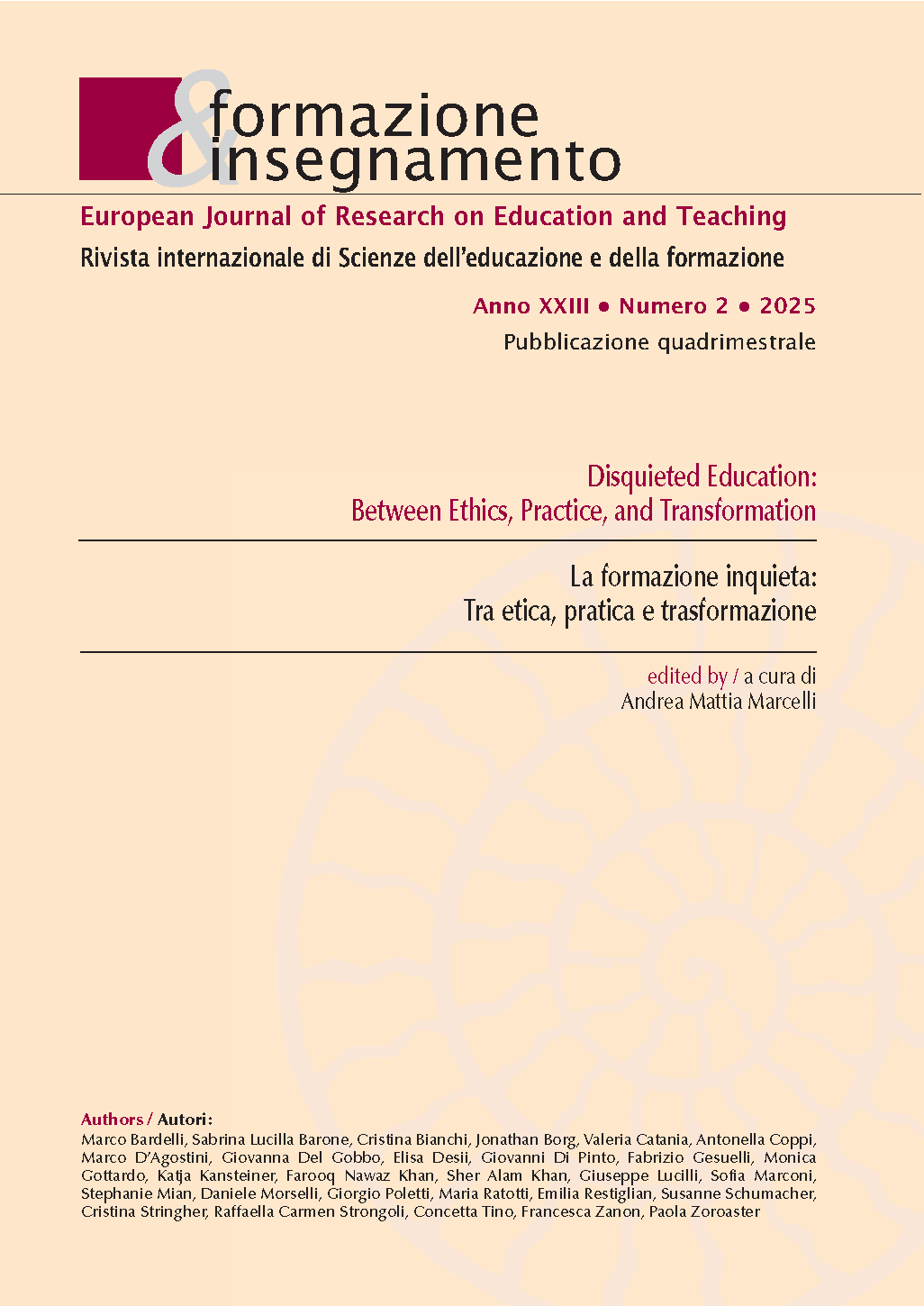
Une éducation inquiète : Entre éthique, pratique et transformation
DOI :
https://doi.org/10.7346/-fei-XXIII-02-25_01Mots-clés :
Inquiétude en éducation, Émotions épistémiques, Risque éducatif, Apprentissage transformateur, Formation de la subjectivitéRésumé
En guise de provocation à l’égard d’une science pédagogique orientée vers la dimension vitale, ce numéro propose une lecture qui accorde du crédit aux suggestions littéraires de Pessoa pour réfléchir sur les dimensions épistémologique et pratique de l’inquiétude. En dépassant l’idée d’un simple deuil d’un passé perdu, la transformation au cœur des processus éducatifs se caractérise néanmoins par un certain “côté sombre”, dans lequel le risque — comme le souligne Biesta — est toujours présent et, loin de n’être qu’un simple désarroi, peut devenir un facteur déclencheur capable de déconstruire l’identité individuelle. Les contributions de ce numéro 23(2) de Formazione & insegnamento “flirtent” avec ces notions liées au domaine du possible : innovation, risque (y compris ludique), limites des solutions technologiques, dispositifs de déconstruction de la subjectivité (par exemple : le milieu carcéral) et expériences de maltraitance. Toutefois, l’empreinte de l’espoir demeure constante, sous la forme de recommandations fondées sur des preuves, destinées à jeter les bases des futures bonnes pratiques.
Références
Amenta, G. (2025). Il rispetto violato: Docenti maltrattati, studenti maltrattanti. Mondadori Università.
Arendt, H. (1958). The Crisis in Education. Partisan Review, 25(4), 173–196.
Bannayeva, A., & Sarandöl, A. (2025). Helicopter Parenting: A Review. Psikiyatride Güncel Yaklaşımlar, 17(2), 272–282. https://doi.org/10.18863/pgy.1484671
Bardelli, M., D’Agostini, M., Zanon, F., & Lucilli, G. (2025). Images and University Teaching: A study through Video Analysis in Science Education. Formazione & insegnamento, 23(2), 8040. https://ojs.pensamultimedia.it/index.php/siref/article/view/8040
Biesta, G. J. J. (2013). The Beautiful Risk of Education. Routledge. https://doi.org/10.4324/9781315635866
Boffo, V. (2022). Active Ageing: Il ruolo dell’apprendimento permenente. Epale Journal, 2022(12), 4–8. https://www.indire.it/wp-content/uploads/2020/05/EPALE_JOURNAL_IT_N_12_2022.pdf
Borg, J. (2025). Book Review of Il Rispetto Violato: Docenti Maltrattati, Studenti Maltrattati by Giombattista Amenta. Formazione & Insegnamento, 23(2), 8268. https://ojs.pensamultimedia.it/index.php/siref/article/view/8268
Bourdieu, P. (1972). Esquisse d’une théorie de la pratique. Librairie Droz. https://doi.org/10.3917/droz.bourd.1972.01
Condit, M. (2017). A Comparative Case Study of Transformative Learning Among Conscientious Objectors (10289108) [PhD Thesis, Saybrook University]. ProQuest.
Coppi, A., & Barone, S. L. (2025). Generative talents: A systemic mapping between international literature and pedagogical paradigm. Formazione & Insegnamento, 23(2), 8142. https://ojs.pensamultimedia.it/index.php/siref/article/view/8142
De Bono, E. (1985). Six Thinking Hats (1st ed.). Little, Brown and Company.
DeBellis, V. A., & Goldin, G. A. (2006). Affect and Meta-Affect in Mathematical Problem Solving: A Representational Perspective. Educational Studies in Mathematics, 63(2), 131–147. https://doi.org/10.1007/s10649-006-9026-4
Di Pinto, G. (2025). The theatre laboratory in prison: An opportunity to rebuild oneself and to rebuild healthy relationships with civil society. Formazione & Insegnamento, 23(2), 7996. https://ojs.pensamultimedia.it/index.php/siref/article/view/7996
Di Rienzo, P. (2024). Il lifelong learning come prospettiva politica e teorica per l’educazione degli adulti. Pedagogia Oggi, 22(2), 40–46. https://doi.org/10.7346/PO-022024-05
Dodd, H. F., & Lester, K. J. (2021). Adventurous Play as a Mechanism for Reducing Risk for Childhood Anxiety: A Conceptual Model. Clinical Child and Family Psychology Review, 24(1), 164–181. https://doi.org/10.1007/s10567-020-00338-w
Dozza, L., & Frabboni, F. (Eds.). (2012). Pianeta anziani: Immagini, dimensioni e condizioni esistenziali. FrancoAngeli.
Drozd, E., & Zembrzuska, A. (2013). School Tutoring as a Concept and a Support Method in Student’s Development. Forum Oświatowe, 2(49), 167–175. http://forumoswiatowe.pl/index.php/czasopismo/article/view/81
Fedeli, M., & Frison, D. (2018). Methods to facilitate learning processes in different educational contexts. Form@re, 153–169. https://doi.org/10.13128/FORMARE-24001
Foucault, M. (1975). Surveiller et punir: Naissance de la prison. Gallimard.
Gesuelli, F. (2025). Freedom as Deactivation and Co-Creation: An Action Research Study on Emancipatory Practices in Lower Secondary Education. Formazione & insegnamento, 23(2), 8095. https://ojs.pensamultimedia.it/index.php/siref/article/view/8095
Gottardo, M., & Restiglian, E. (2025). Quality of educational experiences in childcare services: A survey on parents’ perceptions in the city of Padova, Italy. Formazione & Insegnamento, 23(2), 8065. https://ojs.pensamultimedia.it/index.php/siref/article/view/8065
Gramigna, A. (2024a). Il giovane Umberto Margiotta interprete della pedagogia agostiniana. Formazione & insegnamento, 23(1), 6–12. https://doi.org/10.7346/-fei-XXIII-01-25_02
Gramigna, A. (2024b). Umberto Margiotta interprete di John Dewey: A proposito di libertà e liberalismo. Formazione & insegnamento, 22(3), 10–16. https://doi.org/10.7346/-fei-XXII-03-24_02
Gramigna, A. (2025). Umberto Margiotta and the study of Kant: Between history, morality and education. Formazione & insegnamento, 23(2), 7599. https://ojs.pensamultimedia.it/index.php/siref/article/view/7599
Khan, S. A., Poletti, G., & Khan, F. N. (2025). From Chalkboards to Digital Screens: How Classroom Technology Influences Student Academic Behavior, Engagement and Motivation. Formazione & Insegnamento, 23(2), 8162. https://ojs.pensamultimedia.it/index.php/siref/article/view/8162
Khan, S. A., ur Rahim, M., & Naz, F. L. (2023). Effects of Digital Technology on Mathematical Achievements of Primary School Students; Evidences from Khyber Pakhtunkhwa Pakistan. International Journal of Contemporary Issues in Social Sciences, 2(3), 287–293. https://ijciss.org/index.php/ijciss/article/view/62
Marconi, S., Del Gobbo, G., Banchi, C., & Desii, E. (2025). Third Sector Organisations and Cultural Sustainability: A Qualitative Research Study in the Tuscany Region. Formazione & insegnamento, 23(2), 8070. https://ojs.pensamultimedia.it/index.php/siref/article/view/8070
Margiotta, U. (1974). Kant e la formazione dell’uomo moderno. Signorelli.
Mezirow, J. (1991). Transformative Dimensions of Adult Learning (1st ed.). Jossey-Bass.
Mian, S., & Kansteiner, K. (2025). The Potential of Phenomenological Vignettes to Discover Play Experiences in a Game with Perspectives on Teacher Education and EduSpace Lernwerkstatt. Formazione & Insegnamento, 23(2), 8086. https://ojs.pensamultimedia.it/index.php/siref/article/view/8086
Moloney, M., Pope, J., & Donnellan, A. (2023). What Is Mentoring and Who Mentors? In M. Moloney, J. Pope, & A. Donnellan, Professional Mentoring for Early Childhood and Primary School Practice (pp. 15–37). Springer International Publishing. https://doi.org/10.1007/978-3-031-37186-8_2
Morrice, L. (2013). Learning and Refugees: Recognizing the Darker Side of Transformative Learning. Adult Education Quarterly, 63(3), 251–271. https://doi.org/10.1177/0741713612465467
Morselli, D. (2025). The next generation of change makers: Developing entrepreneurship competence in VET through a board game. Formazione & Insegnamento, 23(2), 8012. https://ojs.pensamultimedia.it/index.php/siref/article/view/8012
Murillo, F. (2025). The curriculum of Frankenstein: Or the education of a monster. Journal of Curriculum Studies, 1–12. https://doi.org/10.1080/00220272.2025.2531369
Nussbaum, M. C. (1987). Nature, Function and Capability: Aristotle on Political Distribution (Working Paper No. 31; Wider Working Papers, pp. 1–50). World Institute for Development Economics Research of the United Nations University. https://ageconsearch.umn.edu/record/295560/files/WP31.pdf
Pessoa, F. (2005). Il libro dell’inquietudine (P. Ceccucci, Ed.; O. Abbati & P. Ceccucci, Trans.). Newton Compton.
Rancière, J. (1987). Le maître ignorant: Cinq leçons sur l’émancipation intellectuelle. Fayard.
Ratotti, M. (2025). Critical Thinking and Democratic Participation: A Pedagogical Reinterpretation of Nussbaum. Formazione & insegnamento, 23(2), 8059. https://ojs.pensamultimedia.it/index.php/siref/article/view/8059
Reeve, J., & Halusic, M. (2009). How K-12 teachers can put self-determination theory principles into practice. Theory and Research in Education, 7(2), 145–154. https://doi.org/10.1177/1477878509104319
Schopenhauer, A. (1851). Parerga und Paralipomena: Kleine philosophische Schriften, Volume 2. A. W. Hayn.
Schumacher, S., & Kansteiner, K. (2025). Learning from Pupils’ Experiences about Participatory Practices Playing a Board Game for the Development of a Learning Environment with Implications for Teacher Education. Formazione & Insegnamento, 23(2), 8075. https://ojs.pensamultimedia.it/index.php/siref/article/view/8075
Shakespeare, W. (1604). Hamlet (D. Bevington, Ed.). Internet Shakespeare Editions.
Sheehan, T. J. (1978). Heidegger’s Interpretation of Aristotle: Dynamis and Ereignis: Philosophy Research Archives, 4, 278–314. https://doi.org/10.5840/pra1978413
Stringher, C. (2025). Profile, Orientation, and Activities of the Preschool Teacher in Italy: Cinderella or Queen of the Educational Sector? Formazione & insegnamento, 23(2), 8057. https://ojs.pensamultimedia.it/index.php/siref/article/view/8057
Strongoli, R. C., & Catania, V. (2025). Flipped Learning and Instructional Design in University Settings: A Systematic Qualitative Review. Formazione & insegnamento, 23(2), 7907. https://ojs.pensamultimedia.it/index.php/siref/article/view/7907
Tino, C. (2025). PCTO: Case study on the effectiveness of the experience for students’ skills development and guidance. Formazione & insegnamento, 23(2), 7864. https://ojs.pensamultimedia.it/index.php/siref/article/view/7864
Turgut-Kurt, R., & Sevimli-Celik, S. (2024). Giving children permission for risky play: Teacher variables and reported practices. Journal of Adventure Education and Outdoor Learning, 1–17. https://doi.org/10.1080/14729679.2024.2416960
van Gennep, A. (1981). Les rites de passage: Étude systématique des rites (É. Nourry, Ed.). Éditions A. et J. Picard.
Vilhunen, E. (2023). Epistemic emotions in science learning situations (No. 158; Helsinki Studies in Education, p. 105). Faculty of Educational Sciences, University of Helsinki. https://www.researchgate.net/profile/Elisa-Vilhunen/publication/389508427_dissertation_Vilhunen_2023/links/67c5adc28311ce680c7b61e7/dissertation-Vilhunen-2023.pdf
Zoroaster, P., & Restiglian, E. (2025). Observing peer feedback in preschool. Formazione & insegnamento, 23(2), 7924. https://ojs.pensamultimedia.it/index.php/siref/article/view/7924
Téléchargements
Publié-e
Comment citer
Numéro
Rubrique
Catégories
Licence
(c) Tous droits réservés Andrea Mattia Marcelli 2025

Cette œuvre est sous licence Creative Commons Attribution 4.0 International.
Formazione & insegnamento est distribué sous licence Attribution 4.0 International (CC BY 4.0).
Pour plus de détails, veuillez vous référer à notre Politique de dépôt et d’archivage ainsi qu’à nos Conditions de droits d’auteur et de licences.