Taking the Circular Economy into Account in History Teaching in Cameroon: The Case of the Lower Secondary History Curriculum
DOI:
https://doi.org/10.7346/-feis-XXIV-01-26_06Keywords:
Circular economy, History teaching, Curricula, Eco-history, Secondary schoolAbstract
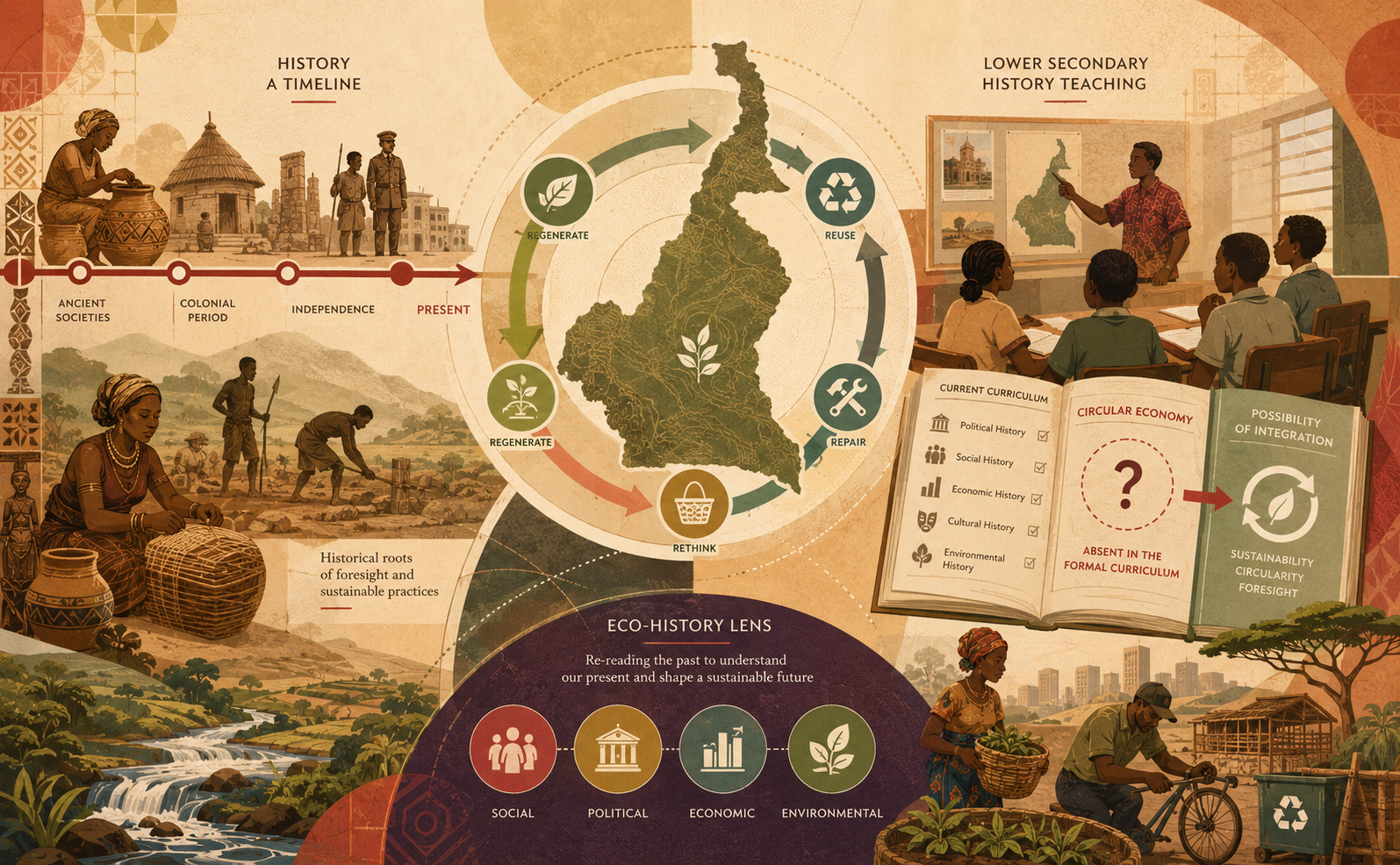
Pursuing cultural, civic, patriotic and intellectual development goals, secondary school history programmes in Cameroon are far from focusing on the ‘good cause’ of environmental education (Moniot, 1991). How can history teaching be aligned with the ecological transition? Our exploratory research is based on a documentary analysis of secondary school history curricula with a view to considering ways of implementing the circular economy. After applying our analysis grid, it appears that the history curricula introduced in secondary schools in 2014 make no reference to the concept of the circular economy. However, works by Braudel (1958), Christian (1991), Moniot (1991), Walter (1994) and Ngong Atembone (2021, 2023a, 2023b) have formulated a way of teaching history that touches on all aspects of social life. That being said, the integration of the circular economy into secondary school history curricula requires, on the one hand, taking into account the historical roots of this concept in ancient societies in Cameroon, which were organised around a mindset of foresight. On the other hand, it requires the deployment of the concept of eco-history, which allows for a new interpretation of social, economic and political facts through the prism of ecological temporality.
References
Abrassart, C., & Aggeri, F. (2002). La naissance de l’éco-conception: Du cycle de vie du produit au management environnemental “produit”. Responsabilité et environnement, 25, 41–63. Retrieved April 28, 2026, from https://www.annales.org/edit/re/2002/re25/abresart41-63.pdf
ADEME. (2018). Économie circulaire. Retrieved April 28, 2026, from https://web.archive.org/web/20231214093340/https://expertises.ademe.fr/economie-circulaire
Braudel, F. (1958). Histoire et sciences sociales: La longue durée. Annales. Économies, sociétés, civilisations, 13(4), 725–753.
Christian, D. (1991). The case for “big history”. Journal of World History, 2(2), 223–238.
Collard, F. (2020). L’économie circulaire. Courrier hebdomadaire du CRISP, 2455–2456(10), 5–72. https://doi.org/10.3917/cris.2455.0005
Debusschere, V., Multon, B., Ben Ahmed, H., Ricordel, C., de Cayeux, M. D., Gourronc, P., & Le Guern, Y. (2010). Enseignement en éco-conception: Une expérience à l’ENS de Cachan ?. Journal sur l’enseignement des sciences et technologies de l’information et des systèmes, 9, Article 0017. https://doi.org/10.1051/j3ea/2010021
Etoga Eily, F. (1971). Sur les chemins du développement: Essai d’histoire des faits économiques du Cameroun. Centre d’édition et de production de manuels et d’auxiliaires de l’enseignement.
Feyler, F. (1995). L’analyse documentaire: Résumer, indexer: Techniques, outils, pratiques. CRDP de Poitou-Charentes.
Gruescu, I. C., & Menet, J. L. (2013). Approches pédagogiques en rapport avec la méthodologie de l’éco-conception dans le cadre des formations licence et master. [Conference presentation]. Retrieved April 28, 2026, from https://hal.science/hal-01078078
Institut EDDEC. (2015). Schéma pédagogique de l’économie circulaire [Figure]. In S. Sauvé, D. Normandin, & M. McDonald (Eds.). L’économie circulaire: Une transition incontournable (pp. 22). Presses de l’Université de Montréal. Retrieved April 28, 2026, from https://library.biblioboard.com/ext/api/media/ee73be7a-8a3a-4b57-9454-625efa1f8c77/assets/external_content.pdf
Kipré, P. (2008). Inventaire critique des manuels scolaires d’histoire en usage dans les pays d’Afrique francophone. UNESCO. Retrieved April 28, 2026, from https://unesdoc.unesco.org/ark:/48223/pf0000180466
Martineau, R. (2012). Fondements et pratiques de l’enseignement de l’histoire à l’école: Traité de didactique. Presses de l’Université du Québec.
Ministère des Enseignements Secondaires du Cameroun. (2014a). Arrêté n° 263/14/MINESEC/IGE du 13 août 2014 portant définition des programmes d'études des classes de 6e et de 5e.
Ministère des Enseignements Secondaires du Cameroun. (2014b). Arrêté n° 419/14/MINESEC/IGE du 9 décembre 2014 portant définition des programmes d'études des classes de 4e et de 3e de l'enseignement secondaire général.
Moniot, H. (1991). L’éducation à l’environnement: Un révélateur du champ didactique, et réciproquement. In A. Giordan, J. L. Martinand, & C. Souchon (Eds.). École et media face aux défis de l’environnement: 13èmes Journées de Chamonix (pp. 63–70). DIRES.
Ngoh, V. (1990). Cameroun 1884–1985: Cent ans d’histoire. CEPER.
Ngong Atembone, J. (2023a). How should history teaching in Cameroon respond to the arrival of the Anthropocene era?. International Journal of History Education and Culture, 44, 87–98. Retrieved April 28, 2026, from https://www.wochenschau-verlag.de/The-Anthropocene-and-History-Education/60083
Ngong Atembone, J. (2023b). Les technocultures: Une réponse alternative aux fragilités de l’enseignement-apprentissage de l’histoire à l’école secondaire camerounaise. In P. Padama, P. F. Enoka, & G. F. Menye Nga (Eds.). L’inspection scolaire et le pilotage pédagogique au Cameroun et en Afrique: Enjeux, défis et perspectives d’un corps d’élite à la croisée des chemins (pp. 187–200). Monange. Retrieved April 28, 2026, from https://www.researchgate.net/publication/385378163_Sous_la_direction_de_PANYA_PADAMA
Ngong Atembone, J. (2021). L’enseignement de l’histoire à l’ère anthropocène: Introduction des dispositifs relatifs à l’éco-histoire et aux technocultures. DICAMES. Doctoral dissertation. Retrieved April 28, 2026, from https://dicames.online/jspui/bitstream/20.500.12177/10472/1/FSE_These_BC_22_0032.pdf
Provost, C. (2006). Amener les élèves à construire leur identité collective ? Le grand défi québécois de la classe d’histoire. Bulletin d’histoire politique, 14(3), 109–124. https://doi.org/10.7202/1054467ar
Sauvé, L. (2017). L’éducation à l’écocitoyenneté. In A. Barthes, J. M. Lange, & N. Tutiaux-Guillon (Eds.). Dictionnaire critique des enjeux et concepts des “éducations à” (pp. 56–64). L’Harmattan.
Sauvé, S., Normandin, D., & McDonald, M. (2016). L’économie circulaire: Une transition incontournable. Presses de l’Université de Montréal.
Walter, F. (1994). L’historien et l’environnement: Vers un nouveau paradigme. Natures Sciences Sociétés, 2(1), 31–39. https://doi.org/10.1051/nss/19940201031
Published
How to Cite
Issue
Section
Categories
License
Copyright (c) 2026 Jacques Ngong Atembone

This work is licensed under a Creative Commons Attribution 4.0 International License.
Formazione & insegnamento is distributed under Attribution 4.0 International (CC BY 4.0).
For further details, please refer to our Repository & Archiving Policy, as well as our Copyright & Licensing Terms.