Design and Pilot Implementation of TRIKIDS: A Pedagogical Method for Circular Economy Education in Primary and Secondary Schools
DOI:
https://doi.org/10.7346/-feis-XXIV-01-26_07Keywords:
MSW, Source separation, Children, Circular economy, TRIKIDS physical prototype, TRIKIDS video game, YaoundéAbstract
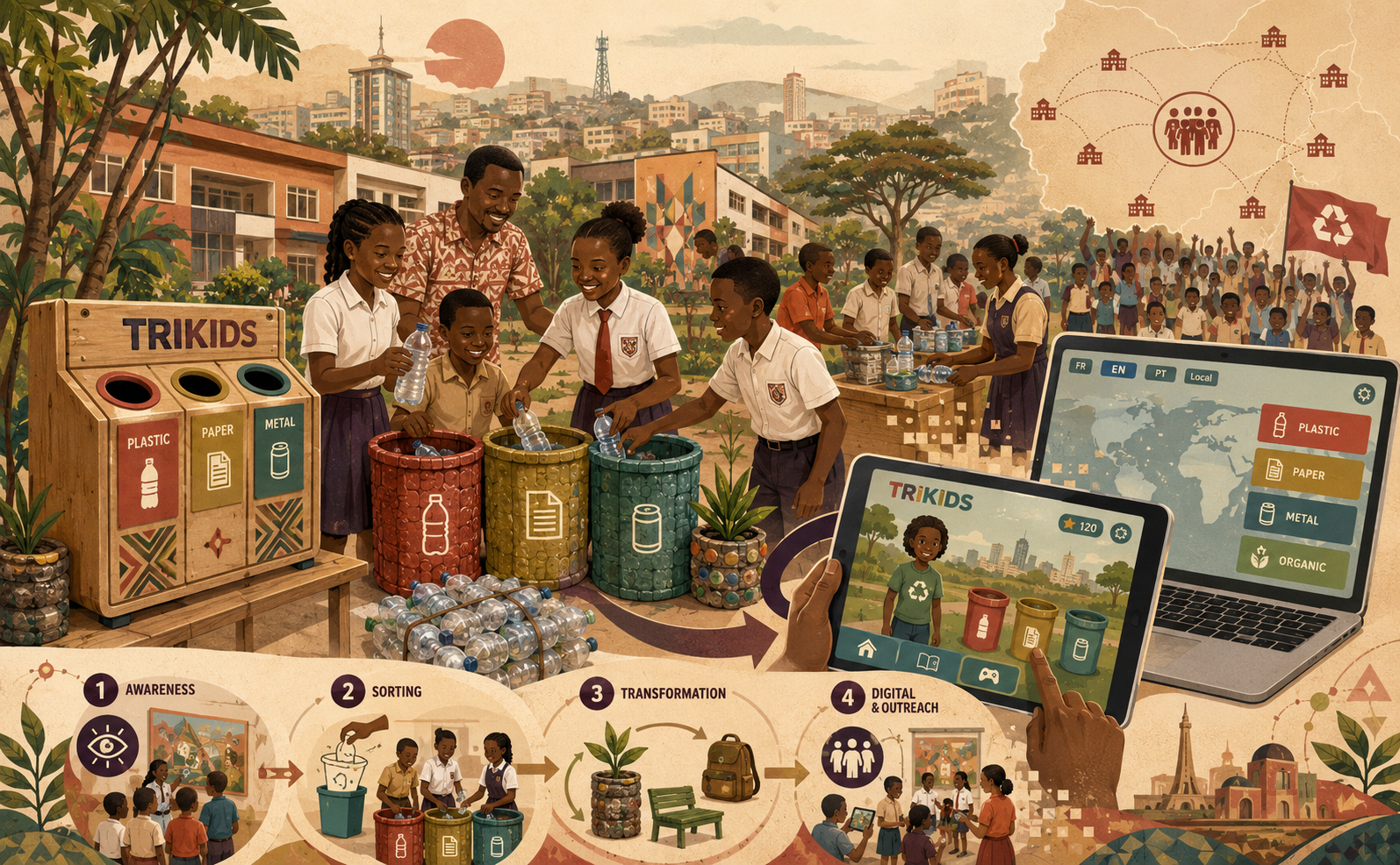
The deficit of pedagogical tools and methods that are simultaneously effective, interactive, and adaptable to local realities and specificities, to educate primary and secondary school students on the source separation of municipal solid waste (MSW), constitutes a major challenge for cities across Africa, the West, and Asia. To address this, a pilot project was conducted in primary and secondary schools in Yaoundé, Cameroon, from January 2020 to December 2024. Based on surveys, literature reviews, interviews, and field observations, the TRIKIDS educational method was developed. This method employs four progressive learning levels that provide participants with a comprehensive introduction to the circular economy. The project also led to the creation of a physical TRIKIDS prototype, which was used to implement the method in a fun and interactive way. As a result, over 10,000 children were engaged alongside their teachers in collecting 5 m³ of plastic PET bottles and fabricating 20 eco-friendly trash cans. This initiative created 10,314 sorting ambassadors throughout the city of Yaoundé. However, the limitations of this physical model highlighted the need for a digital version. We therefore propose a TRIKIDS video game, accessible online, which would be multilingual, cover a wider range of waste types, and be customizable according to local sorting rules and colour codes. This would make education on color-coded waste sorting accessible to a much larger audience.
References
Ajzen, I. (1991). The theory of planned behavior. Organizational Behavior and Human Decision Processes, 50(2), 179–211. https://doi.org/10.1016/0749-5978(91)90020-T
Bruner, J. (1960). The process of education. Harvard University Press.
Deterding, S., Dixon, D., Khaled, R., & Nacke, L. (2011). From game design elements to gamefulness: Defining “gamification”. https://doi.org/10.1145/2181037.2181040
Ellen MacArthur Foundation (2013). Towards the circular economy: Vol. 1. An economic and business rationale for an accelerated transition. Ellen MacArthur Foundation. Retrieved April 18, 2026, from https://content.ellenmacarthurfoundation.org/m/4384c08da576329c/original/Towards-a-circular-economy-Business-rationale-for-an-accelerated-transition.pdf
Kapp, K. M. (2012). The gamification of learning and instruction: Game-based methods and strategies for training and education. Pfeiffer.
Ngambi, J. (2015). Déchets solides ménagers dans la ville de Yaoundé (Cameroun): De la gestion linéaire vers une économie circulaire. Université du Maine. Doctoral dissertation. https://doi.org/10.70675/88d41a89z6ffbz430ez8d0azc063d3dfb8b6
Onibokun, A. G., & Kumuyi, A. J. (Eds.). (2001). La gestion des déchets urbains: Des solutions pour l’Afrique. CDRI/Karthala. Retrieved April 18, 2026, from https://idrc-crdi.ca/sites/default/files/openebooks/927-5/index.html
Piaget, J. (1969). Psychologie et pédagogie. Denoël.
Rosenshine, B. (2012). Principles of instruction: Research-based strategies that all teachers should know. American Educator, 36(1), 12–39. Retrieved April 18, 2026, from https://eric.ed.gov/?id=EJ971753
Published
How to Cite
Issue
Section
Categories
License
Copyright (c) 2026 Adrien Jean Ngaha Ngaha, Louis Bernard Tchuikoua

This work is licensed under a Creative Commons Attribution 4.0 International License.
Formazione & insegnamento is distributed under Attribution 4.0 International (CC BY 4.0).
For further details, please refer to our Repository & Archiving Policy, as well as our Copyright & Licensing Terms.