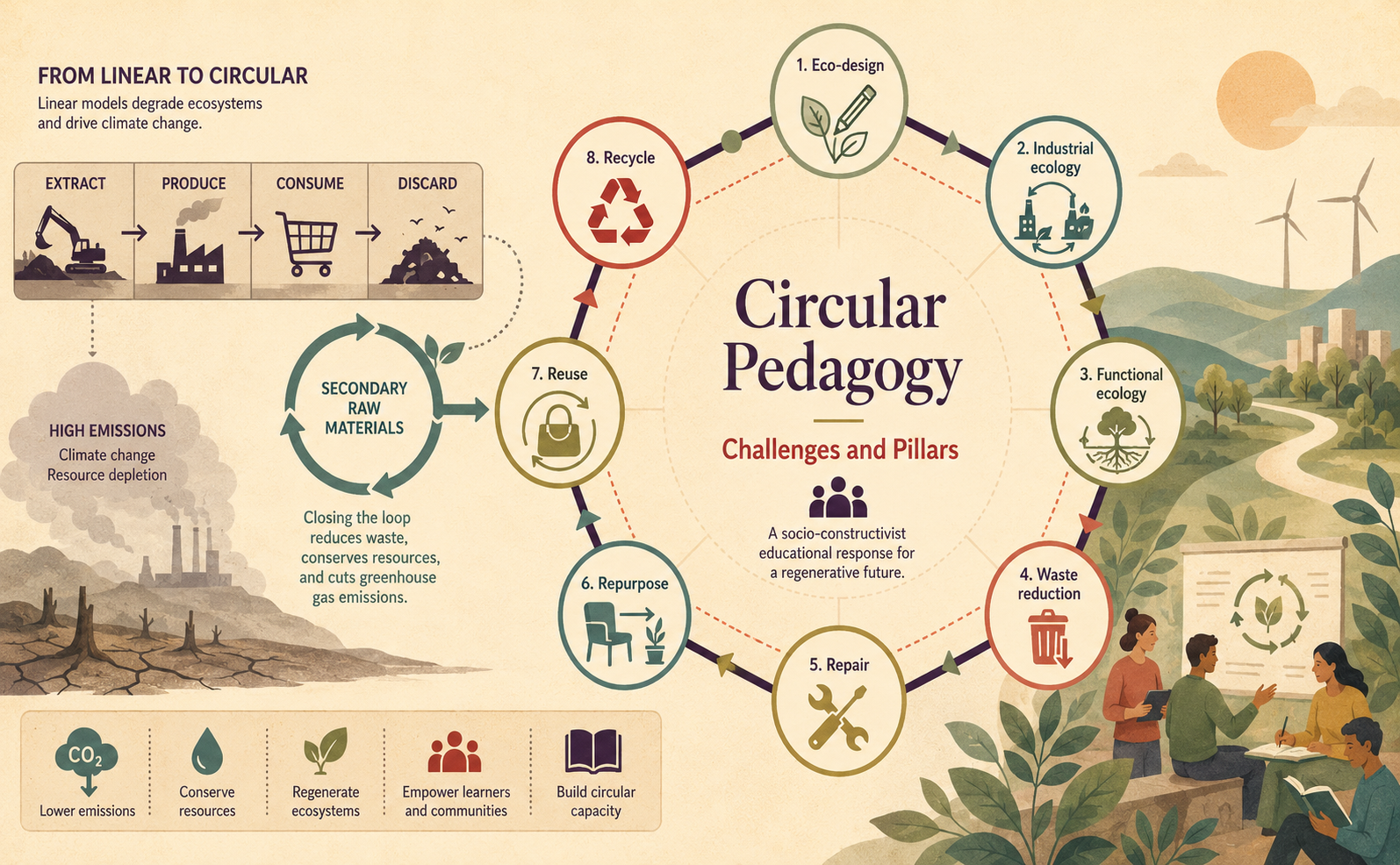
Circular Pedagogy: Challenges and Pillars
DOI:
https://doi.org/10.7346/-feis-XXIV-01-26_02Keywords:
Waste, Linear Economy, Sustainable Development, Circular Economy, Circular PedagogyAbstract
This concept research is situated within the field of sustainable education and examines educational practices from the perspective of the circular economy. The research focuses on the theoretical and practical aspects of circular pedagogy, whose aim is to eliminate waste throughout the life cycle of products and services. Based on a socio-constructivist process, this article aims to deconstruct the linear economic model of “extract-produce-consume-discard”, which is at the origin of greenhouse gas emissions and significant environmental degradation. In this perspective, circular pedagogy no longer considers products at the end of their life cycle as waste, but rather as secondary raw materials.
References
Amherdt, C. H., Dupuich-Rabasse, F., Emery, Y., & Giauque, D. (2000). Compétences collectives dans les organisations: Émergence, gestion et développement. Presses de l’Université Laval.
Bruner, J. S. (1996). The culture of education. Harvard University Press.
Bruner, J. S. (1984). Vygotsky’s zone of proximal development: The hidden agenda. New Directions for Child and Adolescent Development, 1984(23), 93–97. https://doi.org/10.1002/cd.23219842309
Bruner, J. S. (1983). Le développement de l’enfant: Savoir-faire, savoir dire. PUF. M. Deleau, Trans.
Bruner, J. S. (1960). The process of education. Harvard University Press.
Chabani, S., & Bendaoud, Y. (2011). Les compétences collectives: Un nouveau concept dans le milieu professionnel. La Revue des Sciences Commerciales, 10(1), 40–59. Retrieved May 13, 2026, from https://asjp.cerist.dz/en/article/50005
Delors, J. (1996). L’éducation: Un trésor est caché dedans. Odile Jacob.
Dupuich, F. (2011). L’émergence des compétences collectives, vers une gestion durable. Gestion 2000, 28(2), 107–125. https://doi.org/10.3917/g2000.282.0107
Durkheim, É. (1898). Représentations individuelles et représentations collectives. Revue de Métaphysique et de Morale, 6(3), 273–302.
Elamé, E. (2022). Urbanisme durable interculturel au service de la ville africaine de demain. ISTE Group.
Elamé, E. (2016a). La ville durable interculturelle. L’Harmattan.
Elamé, E. (2016b). Pensée négro-africaine et représentations sociales. L’Harmattan.
Elamé, E. (2004). Interculturaliser le développement durable.
Elamé, E., Amilhat-Szary, A. L., & Juge, L. (2014). Social representations of secondary school teachers on sustainable development and their roles in the scholastic environment. Formazione & Insegnamento, 10(1), 203–230. Retrieved May 13, 2026, from https://ojs.pensamultimedia.it/index.php/siref/article/view/830
Ellen MacArthur Foundation. (2014). Towards the circular economy: Vol. 3. Accelerating the scale-up across global supply chains. Global Partners of the Ellen MacArthur Foundation. Retrieved May 13, 2026, from https://www.ellenmacarthurfoundation.org/towards-the-circular-economy-vol-3-accelerating-the-scale-up-across-global
Ellen MacArthur Foundation. (2013). Towards the circular economy: Vol. 2. Opportunities for the consumer goods sector. Founding Partners of the Ellen MacArthur Foundation. Retrieved May 13, 2026, from https://www.ellenmacarthurfoundation.org/towards-the-circular-economy-vol-2-opportunities-for-the-consumer-goods
Ellen MacArthur Foundation. (2012). Towards the circular economy: Vol. 1. Economic and business rationale for an accelerated transition. Founding Partners of the Ellen MacArthur Foundation. Retrieved May 13, 2026, from https://www.ellenmacarthurfoundation.org/towards-the-circular-economy-vol-1-an-economic-and-business-rationale-for-an
Ernst, I. (Ed.). (2002). Cultures urbaines et développement durable. Ministère de l’Aménagement du territoire et de l’Environnement. Edited book.
Freire, P. (2021). La pédagogie des opprimés. Agone.
Grimand, A. (1996). La notion de compétence en gestion des ressources humaines: De la controverse au construit opératoire. Université Lyon 3. Doctoral dissertation. Retrieved May 13, 2026, from https://theses.fr/1996LYO33010
IUCN, WWF, & PNUE. (1980). Stratégie mondiale de la conservation: La conservation des ressources vivantes au service du développement durable. UICN.
Jodelet, D. (1989a). La représentation sociale: Phénomènes, concept et théorie. In S. Moscovici (Ed.). Psychologie sociale (pp. 361–382). PUF.
Jodelet, D. (1989b). Les représentations sociales. PUF.
Lanoie, P., & Normandin, D. (2015). L’économie circulaire. Gestion, 40(3), 90–95. https://doi.org/10.3917/riges.403.0090
Le Boterf, G. (1994). De la compétence: Essai sur un attracteur étrange. Éditions d’Organisation.
Lévy, P. (1994). L’intelligence collective: Pour une anthropologie du cyberspace. La Découverte.
Moscovici, S. (2004). La psychanalyse, son image et son public. PUF. Original work published 1961.
Normandin, D., Sauvé, S., & McDonald, M. (2016). L’économie circulaire: Une transition incontournable. Presses de l’Université de Montréal.
Rabasse, F. (1997). Émergence de compétences collectives au regard des compétences individuelles, dans un processus de transfert des innovations technologiques, dans le domaine des technologies de l’information. CNAM. Doctoral dissertation. Retrieved May 13, 2026, from https://theses.fr/1997CNAM0298
United Nations Conference on Environment and Development. (1992). Agenda 21: The United Nations program of action from Rio. Retrieved May 13, 2026, from https://unesdoc.unesco.org/ark:/48223/pf0000116639
Vygotsky, L. S. (1997). Pensée et langage. La Dispute. F. Sève, Trans.; 3rd ed.; Original work published 1934.
Vygotsky, L. S. (1978). Mind in society: The development of higher psychological processes. Harvard University Press.
World Commission on Environment and Development (1987). Our common future. Oxford University Press.
Published
How to Cite
Issue
Section
Categories
License
Copyright (c) 2026 Esoh Elamé

This work is licensed under a Creative Commons Attribution 4.0 International License.
Formazione & insegnamento is distributed under Attribution 4.0 International (CC BY 4.0).
For further details, please refer to our Repository & Archiving Policy, as well as our Copyright & Licensing Terms.