
School time- Free time crossroads: Background music as a cognitive enhancer in a multitasking generation
Résumé
This study aimed at searching for crossroads between teenagers’ enjoyment and learning, breaking the ancient taboo of bringing chart music in the classroom during classwork simulation. To do this, I decided to investigate the effects of background pop music listening on logical and mathematical performance. Participantsincluded a group of 50 Italian students with a mean age of 16,29 years old. These teenagers from a scientific high school of Rome (Italy) were exposed to 3 different conditions, being Silence-No music, happy-Major mode music and sad-Minor mode music, while completing a battery of tests that included a series of logical-mathematical and spatial tasks. The results showed important differences in performance among the different tests and background conditions.
In particular, a sad attitude towards mathematics seems to be predictive of a better mathematics performance during Minor mode music listening.
The study offers support to previous research about mood-dependent memory and cognitive-emotional induction, indicating that previously acquired mathematical notions and totally new logical solutions can be triggered or inhibited by different music listening choices through acoustic stimulation, with consequent effects on academic areas, and thus possible applications in the emerging field of neurocognitive pedagogy.
Téléchargements
Publié-e
2014-09-30
Comment citer
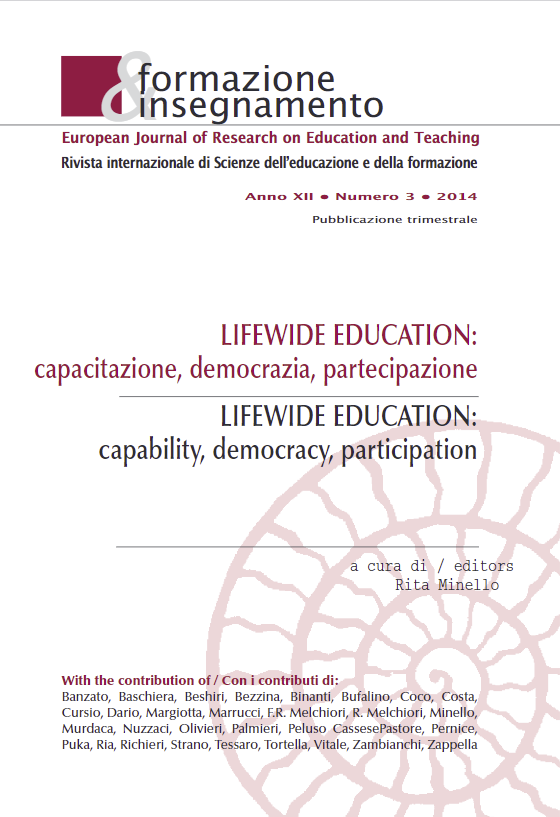
Olivieri, D. (2014). School time- Free time crossroads: Background music as a cognitive enhancer in a multitasking generation. Formazione & Insegnamento, 12(3), 229–250. Consulté à l’adresse https://ojs.pensamultimedia.it/index.php/siref/article/view/1131
Numéro
Rubrique
Articles
Licence
(c) Tous droits réservés Diana Olivieri 2014

Cette œuvre est sous licence Creative Commons Attribution 4.0 International.
Formazione & insegnamento est distribué sous licence Attribution 4.0 International (CC BY 4.0).
Pour plus de détails, veuillez vous référer à notre Politique de dépôt et d’archivage ainsi qu’à nos Conditions de droits d’auteur et de licences.