Transition to a Circular Pedagogy
DOI:
https://doi.org/10.7346/-feis-XXIV-01-26_01Keywords:
Circular pedagogy, European African Diaspora, Inclusive circular economyAbstract
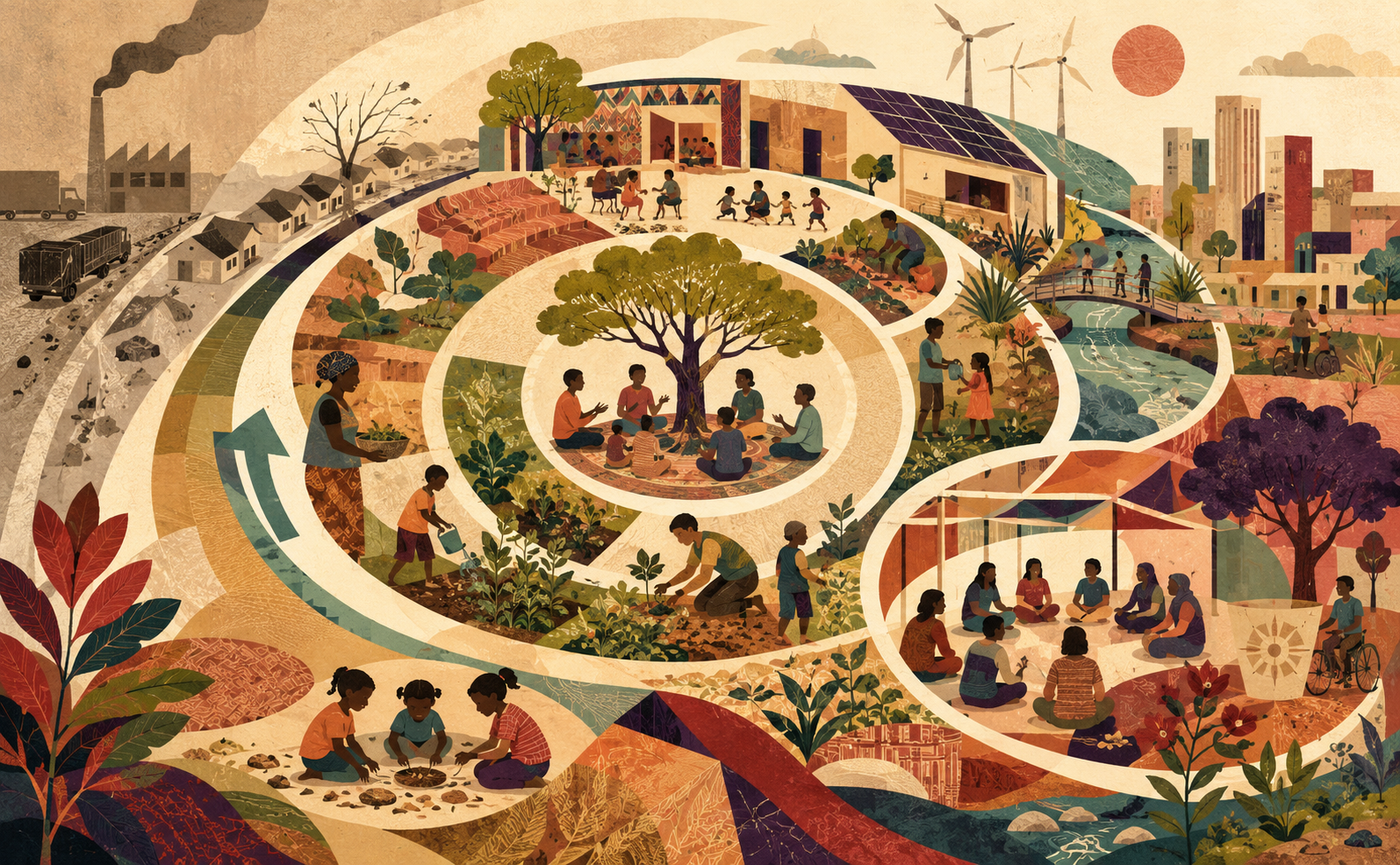
This editorial introduces the special issue 24(S1) "Transition to a Circular Pedagogy", developed within the EurAdice project. Starting from the circular economy as a critique of linear models of production and consumption, it argues that circularity must also be understood as a cultural, territorial and educational question. The contributions gathered in the issue examine circular pedagogy through situated African practices, curricular reinterpretation, school-based experimentation, energy transition, intercultural dialogue, urban pedagogy and childhood education. Together, they show that circular pedagogy is not the simple application of circular-economy principles to education, but a way of making visible the relations among resources, histories, places, knowledge, care and civic responsibility.
References
ADEME. (2018). Economie circulaire. Retrieved February 28, 2025, from http://www.ademe.fr/expertises/economie-circulaire
Archambault, S., & Hervet, B. (2020). Chapitre 15. La ville durable, circulaire par nature. In O. Ortega (Ed.). Fabriquer la ville durable (pp. 207–216). Le Moniteur.
Calabria, C. (2025). Circularity and relationships for the city: Living, Educating, Promoting. Formazione & Insegnamento, 24(S1), 22–29. https://doi.org/10.7346/-feis-XXIV-01-26_04
Cappiello, F. (2026). Telling the Stories of Objects to Learn to Care for Them: Narrative, Inclusion, and Sustainability within Circular Pedagogy in Primary School. Formazione & Insegnamento, 24(S1), 30–37. https://doi.org/10.7346/-feis-XXIV-01-26_05
Diemer, A. (2016). Les symbioses industrielles: Un nouveau champ d’analyse pour l’économie industrielle. Innovations, 50, 65–94.
Elamé, E. (2026). Circular Pedagogy: Challenges and Pillars. Formazione & insegnamento, 24(S1), 5–15. https://doi.org/10.7346/-feis-XXIV-01-26_02
Elamé, E. (Ed.). (2022). Sustainable intercultural urbanism at the service of the African city of tomorrow. John Wiley & Sons. Editor. https://doi.org/10.1002/9781119988380
Macagno, N. (2026). Intercultural Pedagogy and the Circular Educational Paradigm: Designing Educational Dialogues between European and African Students. Formazione & Insegnamento, 24(S1), 16–21. https://doi.org/10.7346/-feis-XXIV-01-26_03
Mewassi Aboui, E. S. M., Voundi, E., & Toksia, D. (2026). Educating and Raising Awareness of the Circular Economy in School and University Settings: The Pilot Experience of Ecological Charcoal in Douala. Formazione & Insegnamento, 24(S1), 56–67. https://doi.org/10.7346/-feis-XXIV-01-26_08
Ngaha Ngaha, A. J., & Tchuikoua, L. B. (2026). Design and Pilot Implementation of TRIKIDS: A Pedagogical Method for Circular Economy Education in Primary and Secondary Schools. Formazione & Insegnamento, 24(S1), 45–55. https://doi.org/10.7346/-feis-XXIV-01-26_07
Ngong Atembone, J. (2026). Taking the Circular Economy into Account in History Teaching in Cameroon: The Case of the Lower Secondary History Curriculum. Formazione & Insegnamento, 24(S1), 38–44. https://doi.org/10.7346/-feis-XXIV-01-26_06
Pearce, D. W., & Turner, R. K. (1989). Economics of natural resources and the environment. Harvester Wheatsheaf. https://doi.org/10.56021/9780801839863
Vialleix, M., & Mariasine, L. (2019). Villes et territoires circulaires: De la théorie à la pratique. HAL. https://hal.science/hal-02356952v1
Published
How to Cite
Issue
Section
Categories
License
Copyright (c) 2025 Esoh Elamé, George Nikolaou

This work is licensed under a Creative Commons Attribution 4.0 International License.
Formazione & insegnamento is distributed under Attribution 4.0 International (CC BY 4.0).
For further details, please refer to our Repository & Archiving Policy, as well as our Copyright & Licensing Terms.