Green Music: Intégrer la nature, la musique et la technologie pour promouvoir la conscience environnementale et l''inclusion en éducation
DOI :
https://doi.org/10.7346/-fei-XXIV-01-26_12Mots-clés :
Éducation à l'environnement, Apprentissage fondé sur la musique, Lien avec la natureRésumé
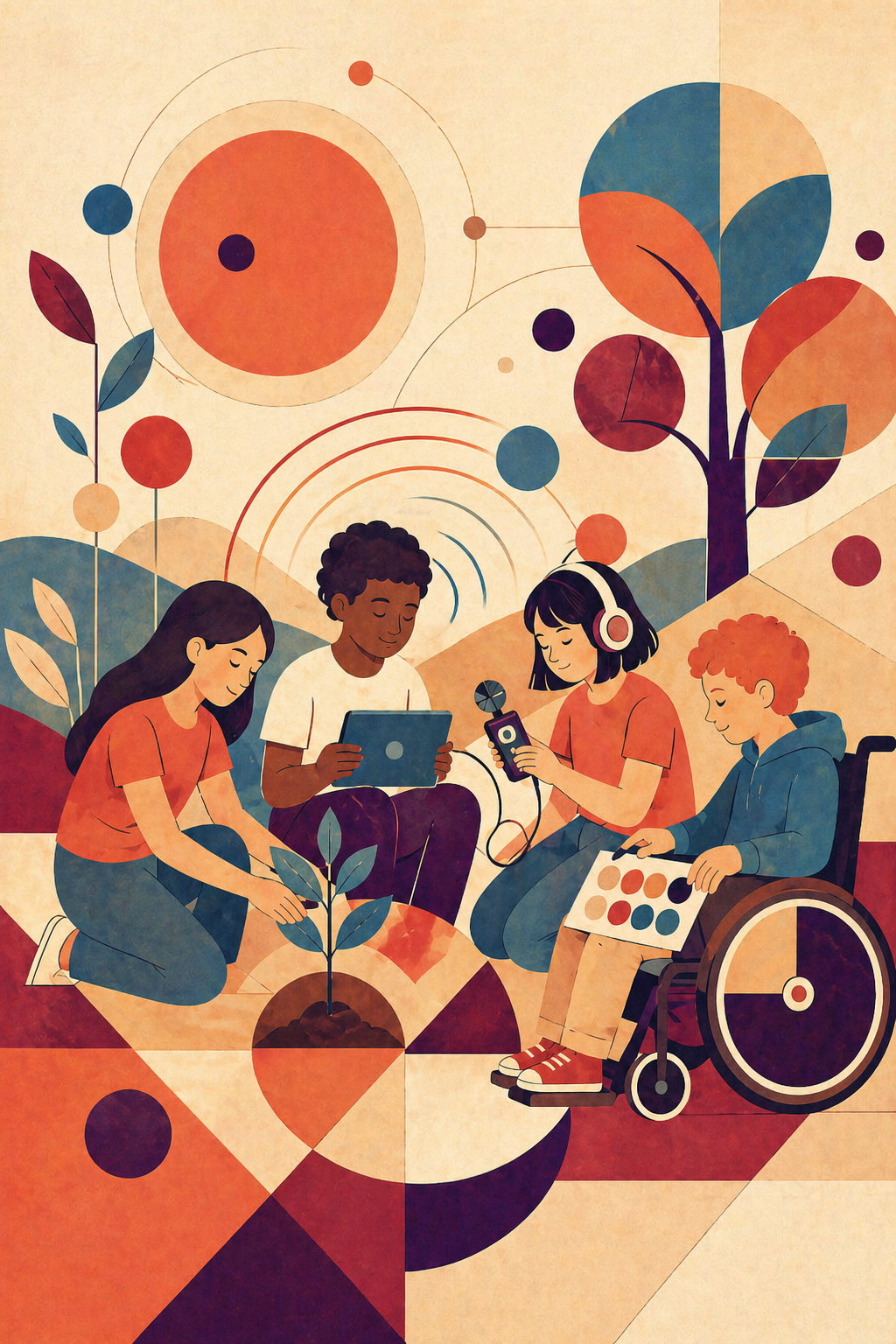
Cette étude présente Green Music, un protocole éducatif visant à favoriser le lien des élèves avec la nature grâce à la musique, à la technologie et à l'apprentissage expérientiel. Ancré dans l'apprentissage expérientiel et l'éducation à l'environnement, il répond à la déconnexion croissante entre l'être humain et la nature en promouvant la conscience écologique et les comportements pro-environnementaux. Mis en oeuvre dans des établissements italiens de l'enseignement secondaire inférieur, le dispositif a accordé une attention particulière à l'inclusion grâce à des technologies à faible coût et à des stratégies adaptatives destinées aux élèves ayant des besoins éducatifs particuliers. Une méthodologie mixte a été adoptée: des données quantitatives issues de la Connectedness to Nature Scale - children (CNS-ch) dans un dispositif prétest-post-test auprès de 114 élèves, et des données qualitatives provenant de réflexions recueillies avec Mentimeter. Les activités ont intégré des séances en plein air avec des dispositifs de biofeedback Plants Play, des tâches réflexives et des productions créatives telles que des podcasts et des récits numériques. Les résultats ont montré une augmentation modeste mais significative du lien avec la nature (t(111) = -2.66, p < .01, Δ = 0.17). Les élèves ont principalement associé la nature à des émotions positives et à des éléments concrets. Dans l'ensemble, Green Music a renforcé l'engagement émotionnel et proposé un modèle inclusif et multisensoriel pour l'éducation à la durabilité.
Références
Barrable, A., & Booth, D. (2020). Increasing nature connection in children: A mini review of interventions. Frontiers in Psychology, 11, Article 492. https://doi.org/10.3389/fpsyg.2020.00492
Berto, R., Pasini, M., & Barbiero, G. (2012). Biofilia sperimentale. Culture della sostenibilità, 5(10), 161–182. Retrieved January 6, 2026, from https://www.univda.it/wp-content/uploads/2018/11/Cult-Sostenibilità-10-161-184.pdf
Blasco-Magraner, J. S., Marín-Liébana, P., Hurtado-Soler, A., & Botella-Nicolás, A. M. (2025). The use of soundscapes in environmental education: Teachers’ competencies in auditory analysis and emotional identification. Behavioral Sciences, 15(6), Article 744. https://doi.org/10.3390/bs15060744
Chawla, L. (2020). Childhood nature connection and constructive hope: A review of research on connecting with nature and coping with environmental loss. People and Nature, 2(3), 619–642. https://doi.org/10.1002/pan3.10128
Deng, H., Ismail, M. A., & Sulaiman, R. (2025). Exploring the impact of biophilic design interventions on children’s engagement with natural elements. Sustainability, 17(7), Article 3077. https://doi.org/10.3390/su17073077
Finestrone, F., Savino, F. P., & di Furia, M. (2024). Music of nature: Case study of an innovative teaching methodology. In G. Casalino, R. Di Fuccio, G. Fulantelli, P. Raviolo, P. C. Rivoltella, D. Taibi, & G. A. Toto (Eds.). International Conference on Higher Education Learning Methodologies and Technologies Online (pp. 580–591). Springer Cham. https://doi.org/10.1007/978-3-031-67351-1_38
Giusti, M., Mäkelä, V. T. A., Skagerlid, A. G., & Nagatsu, M. (2025). Shifting relationships with nature through schools: Exploring the social and spatial context for transformative sustainability education. Ecology and Society, 30(2), Article 34. https://doi.org/10.5751/ES-15969-300234
Guo, M., Su, H., & Yue, L. (2020). Ecology-focused aesthetic music education as a foundation of the sustainable development culture. Interdisciplinary Science Reviews, 45(4), 564–580. https://doi.org/10.1080/03080188.2020.1820154
Hacking, E. B., Bastos, E., Hogarth, H., Sands, B., Dunkley, R., Wenham, L., Saputra, A., McCabe, O. F., Fletcher, A., Nashid, A. A., Anjani, A., & Davies, B. (2023). Mosaicking childhoodnature relations: Situated encounters with country in times of climate change. Children's Geographies. https://doi.org/10.1080/14733285.2023.2285473
Jensen, J. K., Alkan Olsson, J., von Post, M., & Isaksson, C. (2024). Reconnecting children to nature: The efficacy of a wildlife intervention depends on local nature and socio-economic context, but not on urbanisation. People and Nature, 6(5), 1987–2000. https://doi.org/10.1002/pan3.10702
Kolb, A. Y., & Kolb, D. A. (2006). Learning styles and learning spaces: A review of the multidisciplinary application of experiential learning theory in higher education. In R. R. Sims, & S. J. Sims (Eds.). Learning styles and learning: A key to meeting the accountability demands in education (pp. 45–91). Nova Science.
Kolb, D. A. (1984). Experiential learning: Experience as the source of learning and development. Prentice-Hall.
Mayer, F. S., & Frantz, C. M. (2004). The connectedness to nature scale: A measure of individuals’ feeling in community with nature. Journal of Environmental Psychology, 24(4), 503–515. https://doi.org/10.1016/j.jenvp.2004.10.001
Pirchio, S., Passiatore, Y., Panno, A., Cipparone, M., & Carrus, G. (2021). The effects of contact with nature during outdoor environmental education on students’ wellbeing, connectedness to nature and pro-sociality. Frontiers in Psychology, 12, Article 648458. https://doi.org/10.3389/fpsyg.2021.648458
Priest, S. (1986). Redefining outdoor education: A matter of many relationships. The Journal of Environmental Education, 17(3), 13–15. https://doi.org/10.1080/00958964.1986.9941413
Wilson, E. O. (1984). Biophilia. Harvard University Press.
Téléchargements
Publié-e
Comment citer
Numéro
Rubrique
Catégories
Licence
(c) Tous droits réservés Francesca Finestrone 2026

Cette œuvre est sous licence Creative Commons Attribution 4.0 International.
Formazione & insegnamento est distribué sous licence Attribution 4.0 International (CC BY 4.0).
Pour plus de détails, veuillez vous référer à notre Politique de dépôt et d’archivage ainsi qu’à nos Conditions de droits d’auteur et de licences.