
Green Music: Integrating Nature, Music, and Technology to Foster Environmental Awareness and Inclusion in Education
DOI:
https://doi.org/10.7346/-fei-XXIV-01-26_12Keywords:
Environmental education, Music-based Learning, Nature ConnectednessAbstract
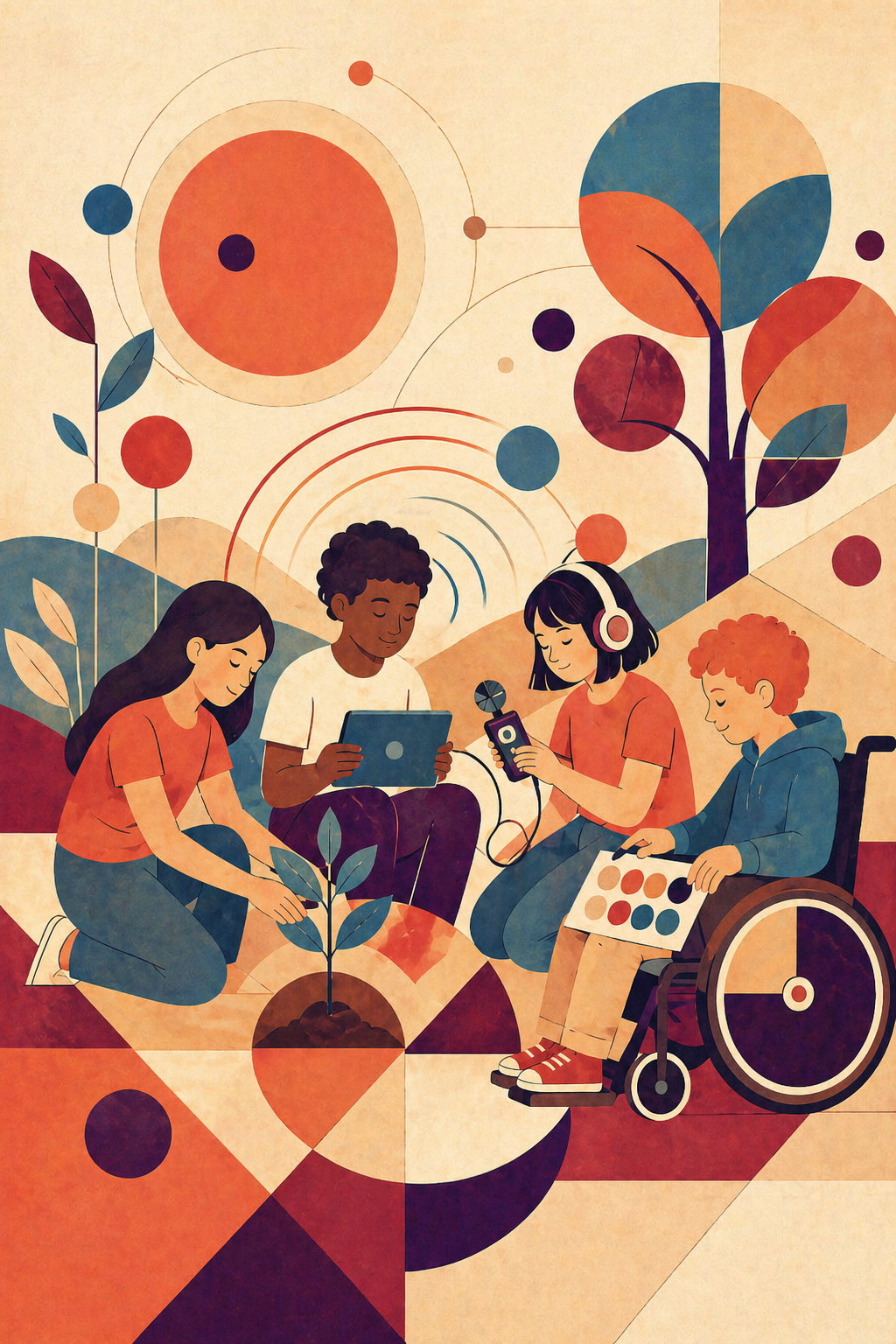
This study presents Green Music, an educational protocol fostering students’ connection to nature through music, technology, and experiential learning. Rooted in experiential learning and environmental education, it addresses the increasing human-nature disconnection by promoting ecological awareness and pro-environmental behaviors. Implemented in Italian lower secondary schools, the intervention emphasized inclusion through low-cost technologies and adaptive strategies for students with special needs. A mixed-methods design was used: quantitative data from the Connectedness to Nature Scale - children (CNS-ch) in a pre-post design with 114 students, and qualitative data from Mentimeter reflections. Activities integrated outdoor sessions with Plants Play biofeedback devices, reflection tasks, and creative outputs such as podcasts and digital storytelling. Results showed a modest but significant increase in connectedness to nature (t(111) = -2.66, p < .01, Δ = 0.17). Students associated nature mainly with positive emotions and tangible elements. Overall, Green Music enhanced emotional engagement and provided an inclusive, multisensory model for sustainability education.
References
Barrable, A., & Booth, D. (2020). Increasing nature connection in children: A mini review of interventions. Frontiers in Psychology, 11, Article 492. https://doi.org/10.3389/fpsyg.2020.00492
Berto, R., Pasini, M., & Barbiero, G. (2012). Biofilia sperimentale. Culture della sostenibilità, 5(10), 161–182. Retrieved January 6, 2026, from https://www.univda.it/wp-content/uploads/2018/11/Cult-Sostenibilità-10-161-184.pdf
Blasco-Magraner, J. S., Marín-Liébana, P., Hurtado-Soler, A., & Botella-Nicolás, A. M. (2025). The use of soundscapes in environmental education: Teachers’ competencies in auditory analysis and emotional identification. Behavioral Sciences, 15(6), Article 744. https://doi.org/10.3390/bs15060744
Chawla, L. (2020). Childhood nature connection and constructive hope: A review of research on connecting with nature and coping with environmental loss. People and Nature, 2(3), 619–642. https://doi.org/10.1002/pan3.10128
Deng, H., Ismail, M. A., & Sulaiman, R. (2025). Exploring the impact of biophilic design interventions on children’s engagement with natural elements. Sustainability, 17(7), Article 3077. https://doi.org/10.3390/su17073077
Finestrone, F., Savino, F. P., & di Furia, M. (2024). Music of nature: Case study of an innovative teaching methodology. In G. Casalino, R. Di Fuccio, G. Fulantelli, P. Raviolo, P. C. Rivoltella, D. Taibi, & G. A. Toto (Eds.). International Conference on Higher Education Learning Methodologies and Technologies Online (pp. 580–591). Springer Cham. https://doi.org/10.1007/978-3-031-67351-1_38
Giusti, M., Mäkelä, V. T. A., Skagerlid, A. G., & Nagatsu, M. (2025). Shifting relationships with nature through schools: Exploring the social and spatial context for transformative sustainability education. Ecology and Society, 30(2), Article 34. https://doi.org/10.5751/ES-15969-300234
Guo, M., Su, H., & Yue, L. (2020). Ecology-focused aesthetic music education as a foundation of the sustainable development culture. Interdisciplinary Science Reviews, 45(4), 564–580. https://doi.org/10.1080/03080188.2020.1820154
Hacking, E. B., Bastos, E., Hogarth, H., Sands, B., Dunkley, R., Wenham, L., Saputra, A., McCabe, O. F., Fletcher, A., Nashid, A. A., Anjani, A., & Davies, B. (2023). Mosaicking childhoodnature relations: Situated encounters with country in times of climate change. Children's Geographies. https://doi.org/10.1080/14733285.2023.2285473
Jensen, J. K., Alkan Olsson, J., von Post, M., & Isaksson, C. (2024). Reconnecting children to nature: The efficacy of a wildlife intervention depends on local nature and socio-economic context, but not on urbanisation. People and Nature, 6(5), 1987–2000. https://doi.org/10.1002/pan3.10702
Kolb, A. Y., & Kolb, D. A. (2006). Learning styles and learning spaces: A review of the multidisciplinary application of experiential learning theory in higher education. In R. R. Sims, & S. J. Sims (Eds.). Learning styles and learning: A key to meeting the accountability demands in education (pp. 45–91). Nova Science.
Kolb, D. A. (1984). Experiential learning: Experience as the source of learning and development. Prentice-Hall.
Mayer, F. S., & Frantz, C. M. (2004). The connectedness to nature scale: A measure of individuals’ feeling in community with nature. Journal of Environmental Psychology, 24(4), 503–515. https://doi.org/10.1016/j.jenvp.2004.10.001
Pirchio, S., Passiatore, Y., Panno, A., Cipparone, M., & Carrus, G. (2021). The effects of contact with nature during outdoor environmental education on students’ wellbeing, connectedness to nature and pro-sociality. Frontiers in Psychology, 12, Article 648458. https://doi.org/10.3389/fpsyg.2021.648458
Priest, S. (1986). Redefining outdoor education: A matter of many relationships. The Journal of Environmental Education, 17(3), 13–15. https://doi.org/10.1080/00958964.1986.9941413
Wilson, E. O. (1984). Biophilia. Harvard University Press.
Downloads
Published
How to Cite
Issue
Section
Categories
License
Copyright (c) 2026 Francesca Finestrone

This work is licensed under a Creative Commons Attribution 4.0 International License.
Formazione & insegnamento is distributed under Attribution 4.0 International (CC BY 4.0).
For further details, please refer to our Repository & Archiving Policy, as well as our Copyright & Licensing Terms.