
Que jogo você está jogando? Jogo real, jogo digital, ludicidade: resultados preliminares de uma pesquisa exploratória
DOI:
https://doi.org/10.7346/-fei-XXIV-01-26_08Palavras-chave:
Ludicidade, Jogo Real, Jogo Digital, Educação InclusivaResumo
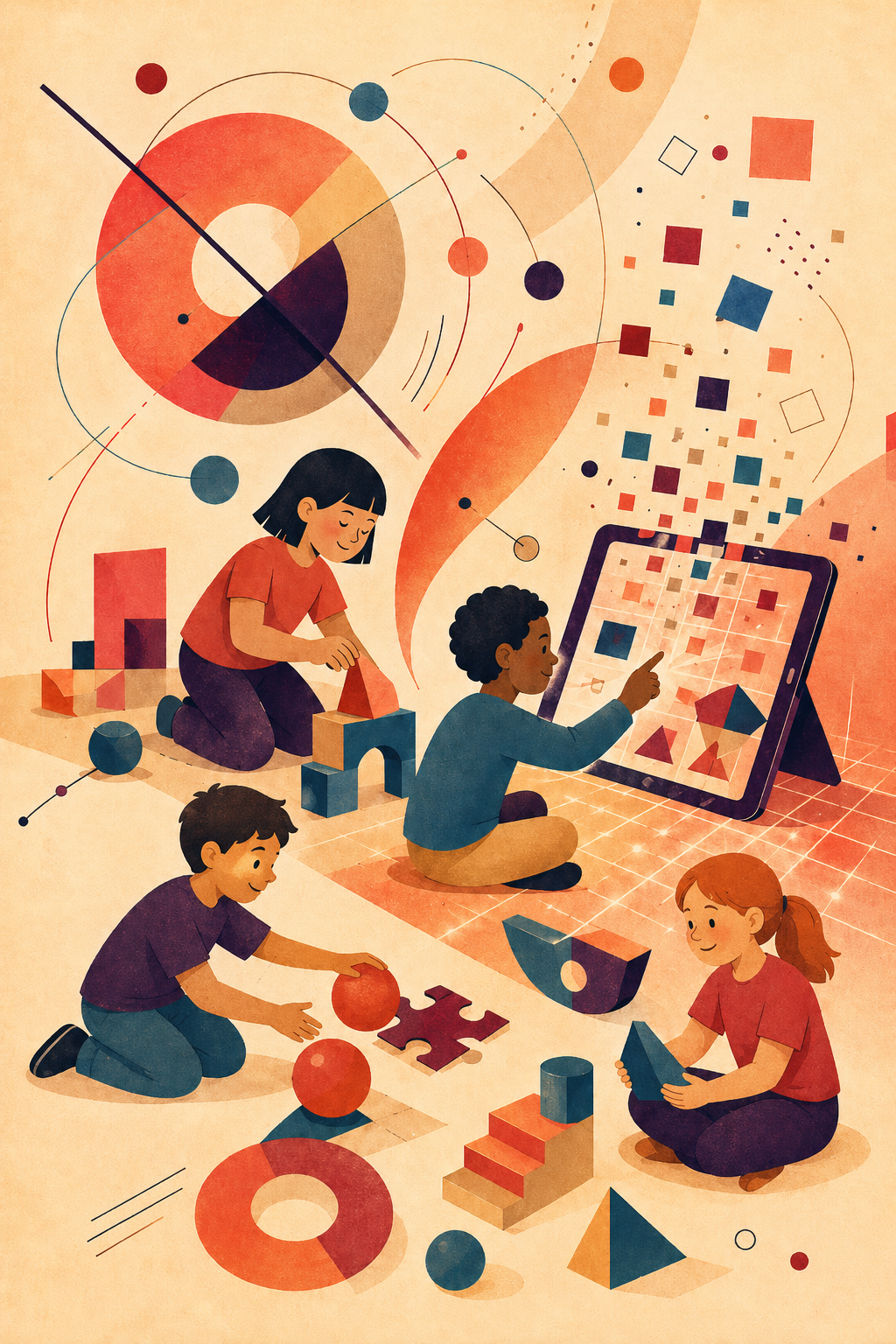
O construto da ludicidade, definido como a disposição da criança para brincar, encontra importante aplicação tanto em relação ao jogo real quanto ao jogo digital. Isso implica uma abordagem ativa da aprendizagem, na qual as crianças podem explorar, experimentar e resolver problemas em contextos reais ou digitais. A literatura científica pertinente investigou a ludicidade em relação a diferentes dimensões, a fim de compreender de que modo as crianças se aproximam do jogo e quais benefícios dele decorrem. Partindo dessas premissas e considerando o jogo como uma dimensão fundamental do desenvolvimento infantil, inclusive na presença de deficiências ou dificuldades de várias naturezas, foi realizada uma pesquisa exploratória com o objetivo de identificar a percepção e a representação de futuros professores de apoio à infância sobre a motivação intrínseca e a percepção de controle da criança em relação ao jogo real e ao jogo digital, duas dimensões que caracterizam a ludicidade.
Referências
Alvarez, L., Rios, A. M., Adams, K., Encarnação, P., & Cook, A. M. (2013). From infancy to early childhood: The role of augmentative manipulation robotic tools in cognitive and social development for children with motor disabilities. In J. L. Pons, D. Torricelli, & M. Pajaro (Eds.). Converging clinical and engineering research on neurorehabilitation (pp. 905–909). Springer. https://doi.org/10.1007/978-3-642-34546-3_147
Bach, J. F., Houdé, O., Léna, P., & Tisseron, S. (2016). Il bambino e gli schermi: Raccomandazioni per genitori e insegnanti. Guerini Scientifica.
Bandura, A. (1997). Self-efficacy: The exercise of control. Freeman.
Barnett, L. A. (2007). The nature of playfulness in young adults. Personality and Individual Differences, 43(4), 949–958. https://doi.org/10.1016/j.paid.2007.02.018
Barnett, L. A. (1990). Playfulness: Definition, design, and measurement. Play and Culture, 3, 319–336.
Besio, S. (2018). Un nuovo modello per il gioco del bambino con disabilità: L’Azione COST «LUDI – Play for Children with Disabilities». L’integrazione scolastica e sociale, 17(4), 307–314. Retrieved January 6, 2026, from https://rivistedigitali.erickson.it/integrazione-scolastica-sociale/it/visualizza/pdf/1658
Blackwell, C. K., Wartella, E., Lauricella, A. R., & Robb, M. (2015). Technology in the lives of educators and early childhood programs: Trends in access, use, and professional development from 2012 to 2014. Northwestern University.
Bobbio, A., & Bondioli, A. (2019). Gioco e infanzia: Teorie e scenari educativi. Carocci.
Bonarini, A., & Jansens, R. (2020). Usability and accessibility of toys and technologies for play for children with disabilities: Scoping review of guidelines and tools. In D. Bulgarelli (Ed.). Perspectives and research on play for children with disabilities (pp. 83–105). De Gruyter.
Braun, V., & Clarke, V. (2006). Using thematic analysis in psychology. Qualitative Research in Psychology, 3(2), 77–101. https://doi.org/10.1191/1478088706qp063oa
Bulgarelli, D. (2018). Nido inclusivo e bambini con disabilità: Favorire e supportare il gioco e la comunicazione. Erickson.
Deci, E. L., & Ryan, R. M. (2000). The “what” and “why” of goal pursuits: Human needs and the self-determination of behavior. Psychological Inquiry, 11(4), 227–268. https://doi.org/10.1207/S15327965PLI1104_01
Deci, E. L., & Ryan, R. M. (1985). Intrinsic motivation and self-determination in human behavior. Plenum.
Dhiyaneshwari, R. P., & Chinnasamy, R. D. (2023). Understanding the perspectives and usability of digital games for children with intellectual disabilities. Journal of Applied Engineering and Technological Science, 5(1), 608–621. https://doi.org/10.37385/jaets.v5i1.1657
Dini, S., & Ferlino, L. (2016). La conoscenza tra le dita dei bambini: Imparare e giocare a tempo di app. Italian Journal of Educational Technology, 24(3), 147–157. https://doi.org/10.17471/2499-4324/930
Ferland, F. (2005). The ludic model: Play, children with physical disabilities and occupational therapy. University of Ottawa Press.
Floridi, L. (2020). Pensare l’infosfera. Raffaello Cortina.
Gadamer, H. G. (2004). Verità e metodo. Bompiani.
Gee, J. P. (2007). Good video games + good learning: Collected essays on video games, learning, and literacy. Peter Lang.
Gee, J. P. (2003). What video games have to teach us about learning and literacy. Palgrave Macmillan. https://doi.org/10.1145/950566.9505
Goussot, A. (2015). La pedagogia speciale come scienza delle mediazioni e delle differenze. Aras.
Guernsey, L. (2007). Screen time: How electronic media—from baby videos to educational software—affects your young child. Basic Books.
Howes, C. (1992). The collaborative construction of pretend: Social pretend play functions. SUNY Press.
Ismailova, L. (2021). Using digital technologies in inclusive education for preschool children. https://pdfs.semanticscholar.org/11fb/a9882dbccfa1534f933bd002ab1314e6d28a.pdf
Johnson, S. (2005). Everything bad is good for you: How today’s popular culture is actually making us smarter. Penguin.
Khoo, E. G., Merry, R., Nguyen, N. H., Bennett, T., & MacMillan, N. (2015). iPads and opportunities for teaching and learning for young children. Wilf Malcolm Institute of Educational Research.
Kuckartz, U. (2014). Qualitative text analysis: A guide to methods, practice and using software. Sage.
Kuckartz, U., & Rädiker, S. (2019). Analyzing qualitative data with MAXQDA. Springer VS.
Lauricella, A. R., Blackwell, C. K., & Wartella, E. (2016). The “new” technology environment: The role of content and context on learning and development from mobile media. In R. Barr, & D. N. Linebarger (Eds.). Media exposure during infancy and early childhood (pp. 1–23). Springer. https://doi.org/10.1007/978-3-319-45102-2_1
Lieberman, J. N. (2014). Playfulness: Its relationship to imagination and creativity. Academic Press.
Livingstone, S. (2009). Children and the internet. Polity Press.
Marsh, J. (2017). The internet of toys: A posthuman and multimodal analysis of connected play. Teachers College Record, 116(4), 1–28. https://doi.org/10.1177/016146811711901206
Montessori, M. (1970). La mente del bambino. Garzanti.
Nesti, R. (2017). Game-based learning: Gioco e progettazione ludica in educazione. ETS.
Neumann, M. M., & Neumann, D. L. (2013). Touch Screen Tablets and Emergent Literacy. Early Childhood Education Journal, 42, 231–239. https://doi.org/10.1007/s10643-013-0608-3
OECD. (2017). Gender imbalances in the teaching profession. OECD Publishing.
Organizzazione Mondiale della Sanità. (2017). ICF-CY: Classificazione internazionale del funzionamento, della disabilità e della salute. Erickson.
Parten, M. B. (1932). Social participation among preschool children. Journal of Abnormal and Social Psychology, 27(3), 243–269. https://psycnet.apa.org/doi/10.1037/h0074524
Pennazio, V. (2015). Disabilità, gioco e robotica nella scuola dell’infanzia. Italian Journal of Educational Technology, 23(3), 155–163. https://doi.org/10.17471/2499-4324/816
Piaget, J. (1962). Play, dreams and imitation in childhood. Norton.
Plowman, L., McPake, J., & Stephen, C. (2010). The technologisation of childhood? Young children and technology in the home. Children & Society, 24(1), 63–74. https://doi.org/10.1111/j.1099-0860.2008.00180.x
Prensky, M. (2001). Digital game-based learning. McGraw-Hill.
Ricœur, P. (1986). Dal testo all’azione: Saggi di ermeneutica 2. Jaca Book.
Skard, G., & Bundy, A. C. (2008). Test of playfulness. In L. D. Parham, & L. S. Fazio (Eds.). Play in occupational therapy for children (pp. 71–93). Mosby. 2nd ed. https://doi.org/10.1016/B978-032302954-4.10004-2
Stagnitti, K., O’Connor, C., & Sheppard, L. (2012). Impact of learn to play program on play, social competence, and language. Australian Occupational Therapy Journal, 59, 302–311. https://doi.org/10.1111/j.1440-1630.2012.01018.x
Tisseron, S. (2016). 3-6-9-12: Diventare grandi all’epoca degli schermi digitali. La Scuola.
Vygotskij, L. S. (1978). Mind in society: The development of higher psychological processes. Harvard University Press.
WHO. (2007). International Classification of Functioning Disability and Health: Children and Youth Version (ICF-CY). World Health Organization.
Downloads
Publicado
Como Citar
Edição
Seção
Categorias
Licença
Copyright (c) 2026 Ilaria Viola, Umberto Veneruso, Diana Carmela Di Gennaro

Este trabalho está licenciado sob uma licença Creative Commons Attribution 4.0 International License.
Formazione & insegnamento é distribuído sob a Attribution 4.0 International (CC BY 4.0).
Para obter mais detalhes, consulte nossa Política de Repositório e Arquivamento, bem como nossos Termos de Direitos Autorais e Licenciamento.