El Modelo Integrado de Accesibilidad Neurofuncional (MIAN): Un marco teórico para la comprensión del lenguaje y el aprendizaje en niños con implante coclear
DOI:
https://doi.org/10.7346/-fei-XXIV-02-26_04Palabras clave:
Modelo integrado de accesibilidad neurofuncional, Implantes cocleares, Comprensión del habla, Esfuerzo de escucha, Accesibilidad, Aprendizaje, Educación inclusivaResumen
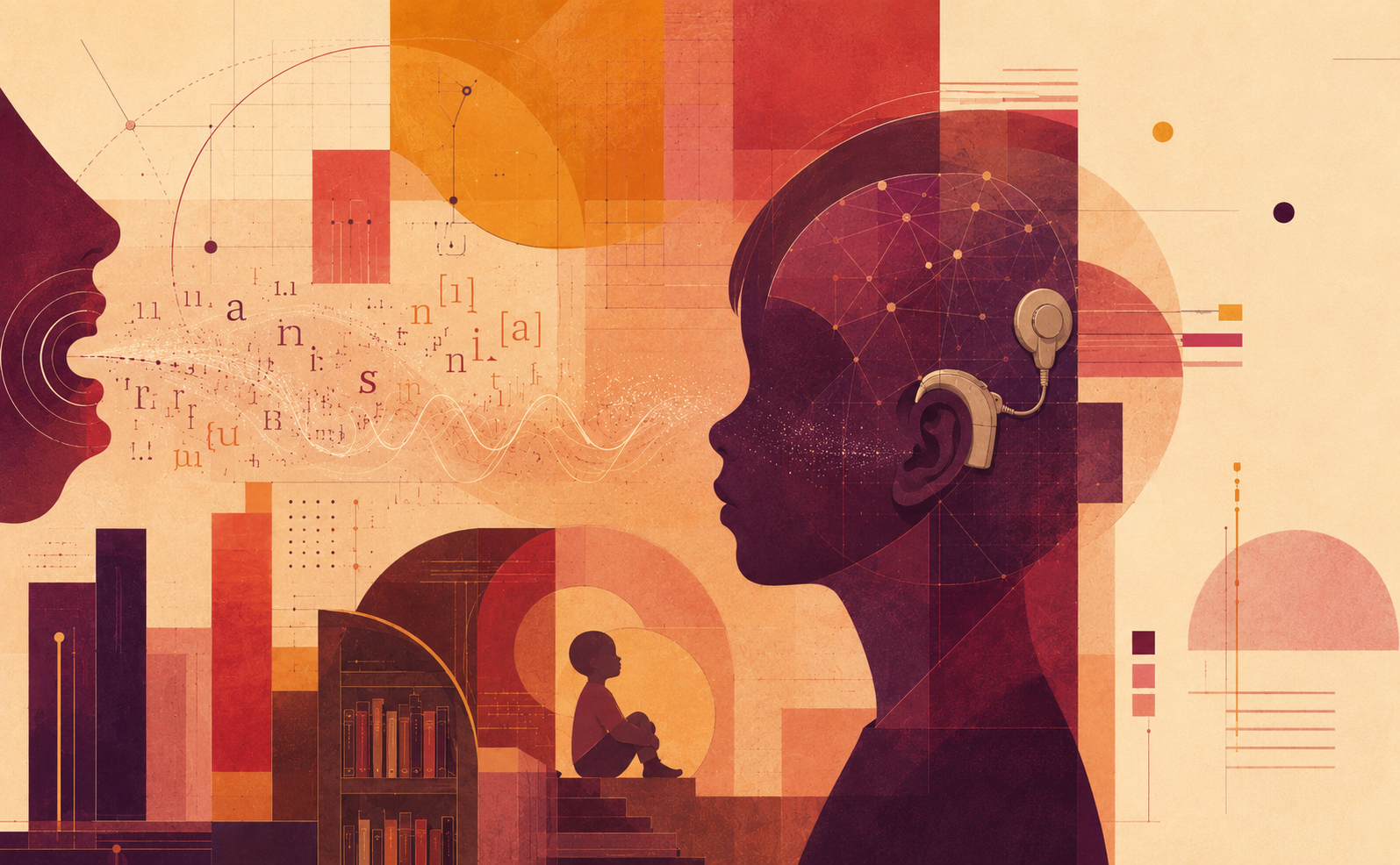
El acceso al lenguaje hablado representa un requisito fundamental para el aprendizaje en contextos educativos. En los niños con implante coclear, la percepción auditiva se restablece mediante la mediación tecnológica, pero el acceso al sonido no garantiza necesariamente una comprensión eficiente del habla ni el aprendizaje. Este artículo presenta el Modelo Integrado de Accesibilidad Neurofuncional (MIAN), un marco teórico que conceptualiza la accesibilidad como una condición neurofuncional que emerge de la interacción entre la calidad de la señal sensorial, la estructura del entorno y la disponibilidad de recursos cognitivos. Dentro de este modelo, la accesibilidad se distingue de la audibilidad y se define como el grado en que la información lingüística puede ser accedida, procesada y estabilizada de manera eficiente por el sistema nervioso para apoyar el aprendizaje. Una accesibilidad reducida incrementa el esfuerzo de escucha, reasigna recursos cognitivos hacia la reconstrucción perceptiva y limita procesos cognitivos de orden superior como la comprensión y la codificación en la memoria. El modelo MIAN integra perspectivas neurocientíficas, cognitivas y educativas para explicar cómo la variabilidad en los resultados de aprendizaje entre los niños con implante coclear puede reflejar diferencias de accesibilidad más que limitaciones cognitivas intrínsecas. El marco destaca el papel de la estructuración ambiental en la optimización de la accesibilidad y la reducción de la carga cognitiva.
Citas
Baddeley, A. D. (2000). The episodic buffer: A new component of working memory. Trends in Cognitive Sciences, 4(11), 417–423. https://doi.org/10.1016/S1364-6613(00)01538-2
Booth, T., & Ainscow, M. (2011). The index for inclusion: Developing learning and participation in schools (3rd ed.). Centre for Studies on Inclusive Education.
Clark, A. (2013). Whatever next? Predictive brains, situated agents, and the future of cognitive science. Behavioral and Brain Sciences, 36(3), 181–204. https://doi.org/10.1017/S0140525X12000477
Florian, L. (2014). What counts as evidence of inclusive education? European Journal of Special Needs Education, 29(3), 286–294. https://doi.org/10.1080/08856257.2014.933551
Florian, L., & Black-Hawkins, K. (2011). Exploring inclusive pedagogy. British Educational Research Journal, 37(5), 813–828. https://doi.org/10.1080/01411926.2010.501096
Friston, K. (2010). The free-energy principle: A unified brain theory? Nature Reviews Neuroscience, 11(2), 127–138. https://doi.org/10.1038/nrn2787
Klatte, M., Bergström, K., & Lachmann, T. (2013). Does noise affect learning? A short review on noise effects on cognitive performance in children. Frontiers in Psychology, 4, Article 578. https://doi.org/10.3389/fpsyg.2013.00578
Kronenberger, W. G., & Pisoni, D. B. (2019). Neurocognitive functioning in deaf children with cochlear implants. In M. Marschark & H. Knoors (Eds.), The Oxford handbook of deaf studies in learning and cognition (pp. 195–208). Oxford University Press. https://doi.org/10.1093/oxfordhb/9780190054045.013.13
McGarrigle, R., Munro, K. J., Dawes, P., Stewart, A. J., Moore, D. R., Barry, J. G., & Amitay, S. (2014). Listening effort and fatigue: What exactly are we measuring? A British Society of Audiology cognition in hearing special interest group “white paper”. International Journal of Audiology, 53(7), 433–440. https://doi.org/10.3109/14992027.2014.890296
Nelson, P. B., Kohnert, K. J., Sabur, S. B., & Shaw, D. (2005). Classroom noise and children learning through a second language: Double jeopardy? Language, Speech, and Hearing Services in Schools, 36(3), 219–229. https://doi.org/10.1044/0161-1461(2005/022)
Pichora-Fuller, M. K., Kramer, S. E., Eckert, M. A., Edwards, B., Hornsby, B. W. Y., Humes, L. E., Lemke, U., Lunner, T., Matthen, M., Mackersie, C. L., Naylor, G., Phillips, N. A., Richter, M., Rudner, M., Sommers, M. S., Tremblay, K. L., & Wingfield, A. (2016). Hearing impairment and cognitive energy: The framework for understanding effortful listening (FUEL). Ear and Hearing, 37, 5S–27S. https://doi.org/10.1097/AUD.0000000000000312
Pisoni, D. B., & Kronenberger, W. G. (2010). Executive function in deaf children with cochlear implants. In M. Marschark & P. E. Spencer (Eds.), The Oxford handbook of deaf studies, language, and education (Vol. 2, pp. 439–457). Oxford University Press.
Pisoni, D. B., Kronenberger, W. G., Roman, A. S., & Geers, A. E. (2011). Measures of digit span and verbal rehearsal speed in deaf children after more than 10 years of cochlear implantation. Ear and Hearing, 32(1 Suppl.), 60S–74S. https://doi.org/10.1097/AUD.0b013e3181ffd58e
Shannon, R. V., Zeng, F. G., Kamath, V., Wygonski, J., & Ekelid, M. (1995). Speech recognition with primarily temporal cues. Science, 270(5234), 303–304. https://doi.org/10.1126/science.270.5234.303
Shield, B. M., & Dockrell, J. E. (2003). The effects of noise on children at school: A review. Journal of Building Acoustics, 10(2), 97–116. https://doi.org/10.1260/135101003768965960
Sweller, J. (1988). Cognitive load during problem solving: Effects on learning. Cognitive Science, 12(2), 257–285. https://doi.org/10.1207/s15516709cog1202_4
UNESCO. (2020). Global education monitoring report 2020: Inclusion and education: All means all. https://unesdoc.unesco.org/ark:/48223/pf0000373718
Wilson, B. S., & Dorman, M. F. (2008). Cochlear implants: A remarkable past and a brilliant future. Hearing Research, 242(1–2), 3–21. https://doi.org/10.1016/j.heares.2008.06.005
Descargas
Publicado
Cómo citar
Número
Sección
Categorías
Licencia
Derechos de autor 2026 Teresa Casacchia

Esta obra está bajo una licencia internacional Creative Commons Atribución 4.0.
Formazione & insegnamento se distribuye bajo la licencia Atribución 4.0 Internacional (CC BY 4.0).
Para más detalles, por favor refiérase a nuestra Política de Repositorio y Archivo, así como a nuestros Términos de Derechos de Autor y Licencia.