Formazione & insegnamento, 24(02), 8668
The Integrated Neurofunctional Accessibility Model (MIAN): A Theoretical Framework for Speech Comprehension and Learning in Children with Cochlear Implants
Il Modello Integrato di Accessibilità Neurofunzionale (MIAN): un framework teorico per la comprensione del linguaggio e l’apprendimento nei bambini con impianto cocleare
ABSTRACT
Access to spoken language represents a fundamental prerequisite for learning in educational contexts. In children with cochlear implants, auditory perception is restored through technological mediation, but access to sound does not necessarily guarantee efficient speech comprehension or learning. The present paper introduces the Integrated Neurofunctional Accessibility Model (MIAN), a theoretical framework that conceptualizes accessibility as a neurofunctional condition emerging from the interaction between sensory signal quality, environmental structure, and cognitive resource availability. Within this model, accessibility is distinguished from audibility and defined as the degree to which linguistic information can be efficiently accessed, processed, and stabilized by the nervous system to support learning. Reduced accessibility increases listening effort, reallocates cognitive resources toward perceptual reconstruction, and constrains higher-order cognitive processes such as comprehension and memory encoding. The MIAN model integrates neuroscientific, cognitive, and educational perspectives to explain how variability in learning outcomes among children with cochlear implants may reflect differences in accessibility rather than intrinsic cognitive limitations. The framework highlights the role of environmental structuring in optimizing accessibility and reducing cognitive load.
L’accesso al linguaggio parlato rappresenta un prerequisito fondamentale per l’apprendimento nei contesti educativi. Nei bambini con impianto cocleare, la percezione uditiva è ripristinata attraverso la mediazione tecnologica, ma l’accesso al suono non garantisce necessariamente né una comprensione efficiente né successo apprenditivo. Questo contributo introduce il Modello Integrato di Accessibilità Neurofunzionale (MIAN), un framework teorico che concettualizza l’accessibilità come una condizione neurofunzionale emergente dall’interazione tra qualità del segnale sensoriale, struttura dell’ambiente e disponibilità delle risorse cognitive. Nel modello, l’accessibilità è distinta dall’udibilità e definita come il grado in cui le informazioni linguistiche possono essere elaborate e stabilizzate in modo efficiente dal sistema nervoso a supporto dell’apprendimento. Una ridotta accessibilità incrementa lo sforzo d’ascolto, rialloca le risorse cognitive verso la ricostruzione percettiva e limita processi superiori quali comprensione e codifica in memoria. Il modello MIAN integra prospettive neuroscientifiche, cognitive ed educative per spiegare come la variabilità negli esiti di apprendimento dei bambini con impianto cocleare possa riflettere differenze di accessibilità piuttosto che limitazioni cognitive intrinseche. Evidenzia il ruolo della strutturazione ambientale nell’ottimizzare l’accessibilità e ridurre il carico cognitivo.
KEYWORDS
Integrated neurofunctional accessibility model, Cochlear implants, Speech comprehension, Listening effort, Accessibility, Learning, Inclusive education
Modello integrato di accessibilità neurofunzionale, Impianto cocleare, Comprensione del linguaggio, Sforzo d’ascolto, Accessibilità, Apprendimento, Educazione inclusiva
AUTHORSHIP
This article is the result of the work of a single Author.
CONFLICTS OF INTEREST
The Author declares no conflicts of interest.
COPYRIGHT AND LICENSE
© Author(s). This article and its supplementary materials are released under a CC BY 4.0 license.
RECEIVED
February 20, 2026
ACCEPTED
July 5, 2026
PUBLISHED ONLINE
July 5, 2026
1. Introduction
Speech comprehension represents the primary gateway through which most school learning is accessed. In hearing children, spoken language provides a continuous, low-effort channel for the transmission of information, allowing cognitive resources to be allocated primarily to meaning construction, memory encoding, and conceptual integration. In contrast, for children with cochlear implants, access to spoken language is mediated by a technological interface that, while enabling auditory perception, does not fully replicate the fidelity, resolution, and automaticity of natural hearing (Wilson & Dorman, 2008; Pisoni et al., 2011).
The cochlear implant restores access to sound by converting acoustic signals into electrical stimulation delivered directly to the auditory nerve. However, this process inherently reduces spectral resolution and alters temporal and intensity cues, requiring the central nervous system to reconstruct linguistic meaning from a degraded or incomplete sensory signal (Shannon et al., 1995; Wilson & Dorman, 2008). As a consequence, speech perception in cochlear implant users is not an automatic perceptual process, but a cognitively mediated reconstruction that places increased demands on attention, working memory, and executive functions (Pichora-Fuller et al., 2016; Kronenberger & Pisoni, 2019).
This increased cognitive demand has been conceptualized as listening effort, defined as the allocation of cognitive resources required to understand auditory input under challenging conditions (McGarrigle et al., 2014). In children with cochlear implants, listening effort represents a chronic and structural condition, rather than a situational one, because even optimal device functioning does not eliminate the need for active cognitive compensation. As a result, a significant proportion of cognitive resources is continuously engaged in decoding the auditory signal itself, reducing the resources available for higher-order learning processes such as comprehension, integration, and memory consolidation (Pisoni & Kronenberger, 2010).
From a neurocognitive perspective, learning depends on the brain’s ability to construct stable internal representations of incoming information. Predictive processing theories propose that the brain continuously generates, and updates models of the environment based on sensory input, and that learning emerges from the progressive refinement of these internal models (Friston, 2010; Clark, 2013). When sensory input is incomplete, degraded, or inconsistent, the construction of stable representations becomes more demanding and less efficient. In the context of cochlear implantation, this means that the accessibility of spoken language cannot be assumed as given but must be understood as a variable condition dependent on both sensory and environmental factors.
Neurofunctional accessibility can therefore be defined as the degree to which the sensory and environmental conditions allow the learner to access linguistic information with sufficient efficiency and stability to enable cognitive processing and learning. Accessibility is not determined solely by the presence of auditory input, but by the quality, clarity, predictability, and structural support of that input within the learning environment. A child may technically “hear” speech but still lack full accessibility if the signal is degraded by noise, distance, reverberation, rapid speech rate, or lack of visual and contextual support.
Environmental structure plays a critical role in determining accessibility. Classrooms are acoustically complex environments, characterized by background noise, multiple sound sources, and reverberation, all of which reduce speech intelligibility even for normally hearing students (Shield & Dockrell, 2003; Klatte et al., 2013). For cochlear implant users, these conditions have a disproportionate impact, because degraded auditory input further increases listening effort and reduces speech comprehension accuracy (Nelson et al., 2005). This shift in cognitive resource allocation has direct consequences for educational outcomes. When a substantial portion of working memory capacity is occupied by perceptual reconstruction, the encoding of new information becomes less efficient, and memory traces may be weaker or incomplete (Baddeley, 2000; Pisoni et al., 2011). Over time, this can result in slower knowledge acquisition, increased fatigue, reduced participation, and apparent learning difficulties that do not originate from cognitive deficits, but from reduced neurofunctional accessibility.
Importantly, accessibility must be understood not as an individual trait, but as a relational property emerging from the interaction between the learner and the environment. The same child may demonstrate high levels of comprehension in an acoustically optimized and visually supported environment, and significantly reduced comprehension in a poorly structured one. This variability reflects the dynamic nature of accessibility as a function of environmental structure, sensory conditions, and cognitive load.
Learning failure cannot be interpreted solely as a property of the learner but must be understood as a consequence of insufficient accessibility. When the environment does not provide conditions that allow efficient access to linguistic information, the brain cannot construct stable representations, and learning is compromised. Conversely, when accessibility is optimized, cognitive resources can be allocated to meaning construction, enabling learning to proceed effectively.
These considerations provide the theoretical foundation for the Integrated Neurofunctional Accessibility Model (MIAN), which conceptualizes accessibility as a structural prerequisite for learning rather than a compensatory adaptation. In children with cochlear implants, accessibility becomes the central factor determining whether auditory input can be transformed into meaningful knowledge.
2. Methodological note
This article is a theoretical-conceptual contribution aimed at developing and formalizing the Integrated Neurofunctional Accessibility Model (MIAN) as an original framework for understanding speech comprehension and learning in children with cochlear implants.
The paper does not present empirical data. Instead, it is based on an interdisciplinary analysis and conceptual integration of literature from neuroscience, cognitive psychology, audiology, hearing sciences, educational research, and inclusive education. The literature was selected according to its relevance to the relationship between sensory access, listening effort, cognitive resource allocation, speech comprehension, and learning processes in children with cochlear implants.
The development of the MIAN model follows a theory-building approach, integrating concepts derived from predictive processing theories, cognitive load theory, executive functioning research, and contemporary frameworks of listening effort and educational accessibility. The purpose of the model is not to replace existing explanatory frameworks, but to provide an integrative perspective capable of explaining how sensory, cognitive, linguistic, and environmental factors interact in determining accessibility to learning.
Accordingly, neurofunctional accessibility is conceptualized as an emergent and dynamic condition resulting from the interaction between the learner and the educational environment. The MIAN model is proposed as a theoretical framework that may guide future empirical research and support the development of accessibility-oriented educational practices.
3. Neurofunctional accessibility as a prerequisite for speech comprehension and learning
In educational contexts, access to spoken language is often implicitly assumed once auditory perception is technically restored through cochlear implantation. However, the presence of auditory input does not necessarily guarantee effective comprehension. Speech comprehension requires not only sensory detection, but the availability of neurofunctional conditions that allow the cognitive system to decode, stabilize, and integrate linguistic information efficiently.
Neurofunctional accessibility refers to the set of sensory, environmental, and cognitive conditions that enable the learner to transform auditory input into meaningful and stable internal representations. Accessibility is not equivalent to audibility. A child may detect sound without being able to process it efficiently enough to support learning. The distinction between audibility and accessibility is critical in understanding the educational functioning of children with cochlear implants.
The auditory signal delivered by a cochlear implant is inherently reduced in spectral resolution compared to natural hearing (Shannon et al., 1995; Wilson & Dorman, 2008). As a consequence, speech perception depends more heavily on top-down cognitive processes, including working memory, attentional control, and predictive mechanisms (Pisoni et al., 2011; Kronenberger & Pisoni, 2019). The brain must actively reconstruct linguistic content from incomplete sensory information, increasing cognitive load and reducing processing efficiency.
This increased cognitive demand directly affects speech comprehension. Working memory plays a central role in maintaining and integrating linguistic information over time (Baddeley, 2000). When a significant portion of working memory resources is allocated to decoding the auditory signal itself, fewer resources remain available for semantic integration and long-term encoding. As a result, comprehension may be slower, less stable, and more vulnerable to disruption.
This mechanism is consistent with cognitive load theory, which posits that learning efficiency depends on the availability of cognitive resources for information processing (Sweller, 1988). When cognitive resources are disproportionately allocated to perceptual decoding, fewer resources remain available for schema construction and knowledge integration.
Environmental conditions play a decisive role in determining the level of neurofunctional accessibility. Speech perception in real-world environments is influenced by multiple acoustic variables, including background noise, reverberation, distance from the speaker, and the presence of competing sound sources (Shield & Dockrell, 2003; Klatte et al., 2013). These factors reduce signal clarity and increase perceptual uncertainty. For cochlear implant users, whose auditory input is already degraded, environmental complexity further amplifies cognitive demand and reduces comprehension efficiency, particularly in noisy classroom-like listening conditions. In poorly structured environments, the cognitive system must continuously compensate for incomplete or ambiguous input. This compensatory effort increases listening effort, defined as the cognitive resources required to understand auditory information under challenging conditions (McGarrigle et al., 2014). Chronic listening effort leads to cognitive fatigue, reduced attentional availability, and decreased learning efficiency over time.
Conversely, when the environment is structured to optimize accessibility, speech comprehension improves. Environmental structuring may include acoustic optimization, reduction of background noise, visual support, predictable linguistic input, and multimodal reinforcement. These conditions reduce perceptual uncertainty, allowing the cognitive system to allocate resources to higher-order learning processes rather than perceptual reconstruction.
Accessibility emerges as a structural prerequisite for learning. Learning does not depend solely on the learner’s cognitive abilities, but on the degree to which the environment provides conditions that allow efficient access to linguistic information. When accessibility is insufficient, learning may be compromised despite intact cognitive potential.
This framework challenges deficit-based interpretations of learning difficulties in children with cochlear implants. Apparent learning limitations may reflect reduced accessibility rather than intrinsic cognitive deficits. Understanding accessibility as a relational and modifiable condition shifts the focus from the learner to the interaction between the learner and the environment.
This conceptualization provides the theoretical foundation for the Integrated Neurofunctional Accessibility Model (MIAN), which proposes that accessibility represents a fundamental determinant of learning. Within this model, speech comprehension is not solely a function of auditory capacity, but the outcome of the interaction between sensory input, cognitive resources, and environmental structure.
4. The Integrated Neurofunctional Accessibility Model (MIAN): theoretical structure and functional mechanisms
The Integrated Neurofunctional Accessibility Model (MIAN) is proposed as an original theoretical framework developed to explain how accessibility to learning emerges from the interaction between sensory, neurocognitive, linguistic, environmental, and sustainability-related processes in children with cochlear implants.
The model was developed in response to a limitation observed in existing approaches to deafness and cochlear implantation. Audiological models primarily focus on sensory restoration, cognitive models emphasize information processing and executive functioning, while educational frameworks mainly address environmental and instructional factors. Although each perspective contributes important insights, none fully explains how these dimensions dynamically interact to determine accessibility to learning.
Unlike audiological models primarily focused on hearing restoration, cognitive models centred on information processing, or educational frameworks emphasizing environmental adaptation, the MIAN model conceptualizes accessibility as a multidimensional neurofunctional property emerging from the interaction among sensory access, neurocognitive processing, linguistic representation, environmental mediation, and cognitive sustainability. Rather than privileging a single explanatory dimension, the model integrates these components within a unified framework aimed at understanding how accessibility influences speech comprehension, participation, and learning.
The MIAN model therefore adopts an integrative neurofunctional perspective, conceptualizing accessibility not as a static condition or a simple consequence of audibility, but as a dynamic and emergent property resulting from the interaction between the learner and the environment. Within this framework, learning depends on the degree to which linguistic information can be accessed, processed, represented, and stabilized with sustainable cognitive effort.
The theoretical foundations of the MIAN model draw upon predictive processing theories (Friston, 2010; Clark, 2013), cognitive load theory (Sweller, 1988), research on working memory and executive functioning (Baddeley, 2000), and contemporary frameworks of listening effort and hearing-related cognitive energy expenditure (McGarrigle et al., 2014; Pichora-Fuller et al., 2016). The model integrates these perspectives within a unified accessibility-oriented framework.
In its current formulation, the MIAN model is organized around five interrelated dimensions: sensory access, neurocognitive processing, linguistic representation, environmental mediation, and cognitive sustainability. These dimensions do not operate independently but interact dynamically to determine the degree of neurofunctional accessibility available to the learner.
The model is grounded in the assumption that the brain operates as a predictive and adaptive system that continuously constructs internal representations of the external environment based on the quality and stability of incoming sensory signals (Friston, 2010; Clark, 2013). When sensory input is degraded, incomplete, or difficult to process, the construction of stable representations requires greater cognitive effort, increasing demands on working memory, attentional control, and executive processes. Under such conditions, learning may be constrained not by limitations in cognitive capacity, but by insufficient accessibility to the information itself.
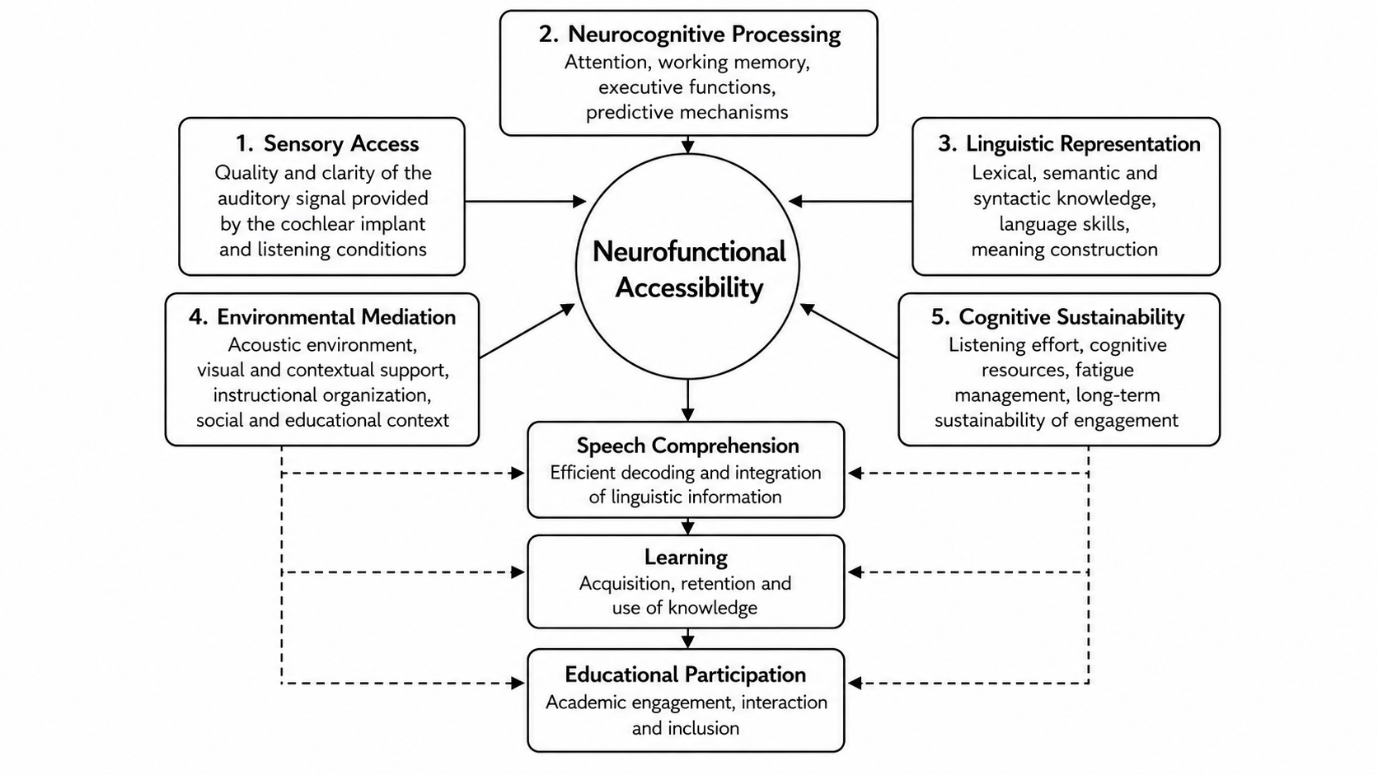
Figure 1. The Integrated Neurofunctional Accessibility Model (MIAN). Conceptual representation of the five interacting dimensions of neurofunctional accessibility (sensory access, neurocognitive processing, linguistic representation, environmental mediation, and cognitive sustainability) and their contribution to speech comprehension, learning, and educational participation.
4.1. Sensory Access
Sensory access refers to the quality, clarity, and usability of the auditory signal available to the learner. In children with cochlear implants, access to spoken language is mediated through electrical stimulation of the auditory nerve, which enables auditory perception but does not fully reproduce the spectral and temporal richness of natural hearing (Wilson & Dorman, 2008; Shannon et al., 1995). Consequently, the accessibility of auditory information depends not only on the presence of sound, but also on signal quality, listening conditions, distance from the speaker, background noise, and device functioning. Within the MIAN framework, sensory access represents the foundational condition upon which all subsequent processing depends. Importantly, sensory access should not be equated with accessibility itself. A child may perceive auditory stimuli and yet experience significant limitations in the efficient processing and use of linguistic information. This distinction highlights the difference between audibility and accessibility, a central assumption of the model.
4.2. Neurocognitive Processing
Neurocognitive processing refers to the set of cognitive mechanisms involved in the decoding, maintenance, integration, and interpretation of linguistic information. Speech comprehension requires the coordinated functioning of working memory, attentional control, executive functions, and predictive mechanisms that allow the learner to construct coherent representations from incoming sensory input (Baddeley, 2000; Friston, 2010; Clark, 2013). When auditory information is incomplete or degraded, greater cognitive resources must be allocated to perceptual reconstruction, increasing cognitive load and reducing the resources available for higher-order learning processes. Within the MIAN model, neurocognitive processing represents the interface through which sensory information is transformed into meaningful cognitive representations.
4.3. Linguistic Representation
Linguistic representation refers to the development and organization of the linguistic system through which sensory information acquires meaning. Accessibility to learning depends not only on auditory perception and cognitive processing, but also on the availability of stable lexical, semantic, and syntactic representations. Language functions as the primary medium through which educational content is interpreted, stored, and communicated. Within this dimension, speech comprehension is understood as the interaction between incoming sensory information and previously established linguistic knowledge. The MIAN framework acknowledges the diversity of possible developmental trajectories, including spoken language, bimodal communication approaches, and bilingual perspectives involving sign and spoken languages. The effectiveness of accessibility ultimately depends on the extent to which linguistic representations support the construction of meaning and participation in learning contexts.
4.4. Environmental Mediation
Environmental mediation refers to the role of the physical, communicative, and educational environment in shaping accessibility. Speech comprehension occurs within contexts characterized by varying levels of acoustic complexity, instructional organization, visual support, and communicative structure. Factors such as classroom acoustics, background noise, reverberation, teacher positioning, visual aids, and instructional predictability influence the degree to which linguistic information can be efficiently accessed and processed. Within the MIAN framework, accessibility is considered a relational property emerging from the interaction between the learner and the environment. Educational environments therefore function not merely as contexts for learning, but as active mediators of accessibility.
4.5. Cognitive Sustainability
Cognitive sustainability refers to the capacity to maintain efficient cognitive functioning over time without excessive expenditure of cognitive resources. This dimension incorporates the concepts of listening effort, cognitive fatigue, attentional endurance, and long-term resource allocation. Children with cochlear implants frequently experience increased listening effort due to the need to reconstruct degraded auditory input, resulting in greater cognitive energy expenditure (McGarrigle et al., 2014; Pichora-Fuller et al., 2016). When cognitive demands persist over extended periods, fatigue may emerge, reducing attentional availability and learning efficiency. Within the MIAN model, accessibility is not evaluated solely in terms of immediate comprehension, but also in terms of the sustainability of cognitive engagement over time. Learning environments characterized by high accessibility reduce unnecessary cognitive effort and support long-term participation, comprehension, and academic achievement.
Within the MIAN framework, neurofunctional accessibility emerges from the dynamic interaction among the five dimensions of the model: sensory access, neurocognitive processing, linguistic representation, environmental mediation, and cognitive sustainability. It represents the degree to which the nervous system can access, process, stabilize, and use linguistic information efficiently enough to support comprehension, participation, and learning. Accessibility is therefore not an intrinsic property of the learner alone, but a relational and dynamic condition that depends on the continuous interaction between the learner and the environment.
Within this model, listening effort represents a key mediating mechanism linking accessibility to learning outcomes. When accessibility is reduced, increased cognitive resources must be allocated to signal decoding and perceptual reconstruction, leaving fewer resources available for higher-order cognitive processes such as semantic integration, abstraction, reasoning, and memory consolidation (McGarrigle et al., 2014; Pichora-Fuller et al., 2016). As a consequence, learning efficiency may be reduced even in the absence of primary cognitive deficits.
The MIAN model challenges deficit-based interpretations of learning difficulties in children with cochlear implants. Traditional approaches often attribute learning variability to intrinsic cognitive limitations. However, the MIAN framework proposes that many observed learning differences may instead reflect variability in neurofunctional accessibility. When accessibility is optimized, cognitive resources can be allocated efficiently to learning processes. When accessibility is reduced, learning may be constrained despite intact cognitive potential. These considerations have important implications for educational practice, suggesting that learning outcomes depend not only on learner characteristics, but also on the sensory, linguistic, cognitive, and environmental conditions that shape accessibility. By optimizing environmental mediation and reducing unnecessary cognitive load, it becomes possible to improve speech comprehension, participation, and learning efficiency.
The MIAN model therefore provides a theoretical framework for understanding learning as a function of accessibility rather than ability. In children with cochlear implants, learning depends fundamentally on the degree to which the environment allows the nervous system to access, stabilize, and process linguistic information under sustainable cognitive conditions. Accessibility is not a compensatory adaptation, but a structural prerequisite for learning.
5. Application of the MIAN model to children with cochlear implants in educational settings
Educational environments represent the primary context in which speech comprehension supports learning. For children with cochlear implants, access to spoken language in the classroom is a necessary condition for participation, comprehension, and knowledge acquisition. However, access to sound through a cochlear implant does not automatically guarantee accessibility to spoken language. The MIAN model provides a framework for understanding how sensory access, neurocognitive processing, linguistic representation, environmental mediation, and cognitive sustainability interact to determine whether spoken language can be effectively transformed into learning.
In educational settings, accessibility depends on the dynamic interaction among the five dimensions of the model. Sensory access influences the quality of the auditory information available to the learner. Neurocognitive processing determines how effectively this information can be decoded and integrated. Linguistic representation provides the semantic and lexical structures necessary for meaning construction. Environmental mediation shapes the conditions under which communication occurs, while cognitive sustainability determines whether comprehension can be maintained over time without excessive expenditure of cognitive resources.
Classroom environments frequently present conditions that challenge accessibility. Background noise, reverberation, distance from the speaker, overlapping conversations, and rapid verbal exchanges increase perceptual uncertainty and reduce signal clarity (Shield & Dockrell, 2003; Klatte et al., 2013). For children with cochlear implants, whose auditory input is already characterized by reduced spectral resolution, these conditions may significantly increase cognitive demands and listening effort.
Within the MIAN framework, reduced accessibility does not merely affect perception; it influences the entire chain of processes that support learning. When auditory information is difficult to access, additional cognitive resources must be allocated to perceptual reconstruction. Consequently, fewer resources remain available for semantic integration, memory encoding, reasoning, and knowledge consolidation (Pisoni et al., 2011; McGarrigle et al., 2014). Learning difficulties may therefore emerge even when intellectual abilities are preserved.
The MIAN model challenges explanations that attribute educational difficulties primarily to learner characteristics. According to this framework, variability in educational performance may reflect differences in accessibility rather than intrinsic limitations in cognitive potential. Learning outcomes can therefore be understood as the product of dynamic interactions among sensory, linguistic, cognitive, and environmental conditions. Educational accessibility can be enhanced through targeted environmental and instructional modifications. Acoustic optimization, reduction of background noise, strategic classroom seating, visual supports, multimodal communication, predictable instructional structures, and explicit linguistic scaffolding may all contribute to reducing listening effort and increasing accessibility. These interventions do not alter the learner’s cognitive capacity; rather, they improve the conditions under which cognitive resources can be effectively allocated to learning.
The model also highlights the importance of considering cognitive sustainability within educational planning. A learner may successfully comprehend information during short periods of instruction while experiencing significant fatigue over longer periods of cognitive engagement. Accessibility should therefore be evaluated not only in terms of immediate performance, but also in relation to the long-term sustainability of participation, attention, and learning.
From an inclusive education perspective, accessibility cannot be reduced to physical presence within the classroom. Genuine inclusion requires conditions that allow learners to access, process, and use linguistic information efficiently and consistently (Booth & Ainscow, 2011; UNESCO, 2020). Within the MIAN framework, inclusion is therefore understood as the creation of environments that support neurofunctional accessibility across sensory, cognitive, linguistic, and educational dimensions.
6. Implications for theory, research, and educational practice
The Integrated Neurofunctional Accessibility Model (MIAN) provides a theoretical framework that reconceptualizes learning in children with cochlear implants as a function of accessibility rather than ability. By formalizing accessibility as a neurofunctional construct, the MIAN model provides a unified theoretical account of how sensory access, neurocognitive processing, linguistic representation, environmental mediation, and cognitive sustainability jointly determine learning efficiency. Such a conceptualization has important implications for theoretical models of learning, empirical research, and educational practice. From a theoretical perspective, the MIAN model challenges traditional deficit-based interpretations of learning variability in children with hearing loss. Conventional approaches often interpret learning difficulties as consequences of intrinsic cognitive limitations or developmental delays. In contrast, the MIAN framework proposes that learning constraints may emerge from insufficient neurofunctional accessibility rather than reduced cognitive capacity. This distinction is critical because it shifts the focus from the learner as the locus of limitation to the interaction between the learner and the sensory and environmental context.
This reconceptualization aligns with contemporary neurocognitive theories that emphasize the role of environmental input in shaping neural processing and learning (Friston, 2010; Clark, 2013). Learning depends on the brain’s ability to construct stable internal representations based on incoming sensory information. When accessibility is reduced, the construction of these representations becomes more effortful and less efficient. As a result, learning outcomes may reflect differences in accessibility rather than differences in cognitive potential.
The MIAN model also contributes to theoretical understanding by integrating sensory access, neurocognitive processing, linguistic representation, environmental mediation, and cognitive sustainability into a unified framework. Previous models have often considered these dimensions separately. Audiological models primarily focus on hearing restoration, cognitive models emphasize information processing, while educational approaches focus on environmental adaptation. The MIAN framework integrates these domains, emphasizing their dynamic interaction in determining accessibility and learning.
From a research perspective, the MIAN model provides a conceptual framework for investigating the mechanisms underlying variability in learning outcomes among children with cochlear implants. Variability in academic performance is well documented in this population (Pisoni et al., 2011; Kronenberger & Pisoni, 2019), but its underlying mechanisms remain incompletely understood. The MIAN model suggests that differences in neurofunctional accessibility may represent a key explanatory factor. Future research may investigate how sensory signal quality, environmental structure, and cognitive resource allocation interact to influence comprehension and learning. Future empirical studies may also contribute to the validation of the MIAN framework by examining the relative contribution of its five dimensions and their relationships with educational participation, academic achievement, and cognitive sustainability.
The model also provides a framework for examining listening effort as a central mechanism linking accessibility and learning. Traditionally viewed as an outcome of auditory processing difficulty, listening effort is reconceptualized within the MIAN framework as a mediating mechanism linking accessibility and learning. By influencing the availability of cognitive resources, it directly affects learning efficiency and may represent a key target for future research on environmental interventions and educational outcomes. From an educational perspective, the MIAN model has direct implications for instructional design and inclusive practice. If learning depends on accessibility, then improving accessibility becomes a primary educational objective. This perspective is consistent with the principles of inclusive pedagogy, which emphasize the design of learning environments that enable the participation and learning of all students by proactively reducing barriers while also recognizing the importance of responding to individual learning needs (Florian & Black-Hawkins, 2011). This requires a shift from focusing exclusively on compensatory strategies directed at the learner to addressing environmental conditions that influence accessibility.
Environmental structuring plays a central role in improving accessibility. Acoustic optimization, reduction of background noise, improved signal clarity, visual support, and predictable instructional organization all contribute to reducing perceptual uncertainty and cognitive load. These modifications improve the efficiency with which linguistic information can be processed and learned.
The MIAN model also provides a theoretical foundation for understanding inclusion as functional accessibility rather than physical placement alone. This perspective is consistent with contemporary approaches to inclusive education, which conceptualize inclusion as the removal of barriers to participation and learning rather than merely ensuring physical placement in mainstream educational settings (Booth & Ainscow, 2011; Florian, 2014; UNESCO, 2020). Educational assessment and intervention should therefore consider accessibility as a central variable in the interpretation of learning difficulties. In children with cochlear implants, educational challenges should not be viewed solely as indicators of cognitive limitation, but also as potential consequences of reduced accessibility. Enhancing accessibility may improve learning outcomes without requiring changes in cognitive capacity.
The MIAN model may also be extended beyond cochlear implantation to other conditions in which learning depends on the interaction among sensory input, cognitive processing, linguistic representation, and environmental structure. In this sense, the framework offers a broader perspective for understanding accessibility as a fundamental determinant of learning across a range of neurodevelopmental and sensory conditions. This perspective is consistent with contemporary approaches to inclusive education, which conceptualize inclusion as the removal of barriers to participation and learning rather than merely ensuring physical placement in mainstream educational settings (Booth & Ainscow, 2011; Florian, 2014). By conceptualizing accessibility as a structural prerequisite for learning, the MIAN model offers a framework for understanding how sensory and environmental conditions shape cognitive processing and educational outcomes. Such an approach may guide both research and educational practice, supporting the development of learning environments that optimize accessibility and promote learning. Ultimately, accessibility emerges not merely as a condition for participation, but as a central neurofunctional determinant of learning itself.
6.1. Future Research and Validation
As a theoretical framework, the MIAN model requires empirical validation through future research. The model generates testable hypotheses concerning the relationships among sensory access, cognitive resource allocation, linguistic representation, listening effort, educational accessibility, and learning outcomes in children with cochlear implants. Future studies may investigate the relative contribution of each dimension and examine how variations in neurofunctional accessibility influence participation, academic achievement, and cognitive sustainability across educational contexts.
The MIAN framework may also provide a basis for the development of assessment tools, observational protocols, and accessibility-oriented educational planning models. Future validation efforts should not be limited to audiological indicators alone, but should include cognitive, linguistic, environmental, and educational variables capable of capturing the multidimensional nature of accessibility.
7. Conclusions
The Integrated Neurofunctional Accessibility Model (MIAN) proposes a theoretical framework for understanding learning in children with cochlear implants as a function of neurofunctional accessibility rather than sensory restoration alone. Access to sound does not necessarily guarantee access to linguistic information in a form that can be efficiently processed, represented, and transformed into learning. Educational functioning depends on the conditions that allow the nervous system to access, stabilize, integrate, and use information under sustainable cognitive conditions.
Within the MIAN framework, accessibility is conceptualized as an emergent property arising from the dynamic interaction among five interrelated dimensions: sensory access, neurocognitive processing, linguistic representation, environmental mediation, and cognitive sustainability. Together, these dimensions determine the degree to which linguistic information can support comprehension, participation, and learning.
The MIAN model shifts the interpretation of learning variability from deficit-based explanations toward an accessibility-oriented understanding of educational functioning. Learning constraints may emerge not from intrinsic cognitive limitations, but from insufficient accessibility to information. Consequently, educational outcomes should be interpreted in relation to the interaction between learner characteristics and the sensory, linguistic, cognitive, and environmental conditions that shape accessibility.
The MIAN model provides an integrative framework for understanding how accessibility influences learning processes and educational participation. By identifying accessibility as a structural prerequisite for learning, the model highlights the importance of designing environments that reduce unnecessary cognitive effort, support speech comprehension, and promote sustainable engagement in learning activities.
Understanding learning through the lens of neurofunctional accessibility provides a framework for interpreting educational functioning in children with cochlear implants. The MIAN model highlights accessibility as a fundamental determinant of educational success and proposes that learning outcomes are shaped not only by individual characteristics, but also by the degree to which the environment supports access to linguistic information. Accessibility therefore emerges not as a compensatory adaptation, but as a structural prerequisite for participation, learning, and inclusion.
Future empirical research will be necessary to validate the model and examine the relative contribution of its dimensions across different educational contexts. Nevertheless, the MIAN framework offers a conceptual foundation for advancing accessibility-oriented approaches to research, educational planning, and inclusive practice in children with cochlear implants and, potentially, in other neurodevelopmental and sensory conditions. Viewed in this way, accessibility emerges not merely as a condition for participation, but as a fundamental neurofunctional determinant of learning itself.
References
Baddeley, A. D. (2000). The episodic buffer: A new component of working memory. Trends in Cognitive Sciences, 4(11), 417–423. https://doi.org/10.1016/S1364-6613(00)01538-2
Booth, T., & Ainscow, M. (2011). The index for inclusion: Developing learning and participation in schools (3rd ed.). Centre for Studies on Inclusive Education.
Clark, A. (2013). Whatever next? Predictive brains, situated agents, and the future of cognitive science. Behavioral and Brain Sciences, 36(3), 181–204. https://doi.org/10.1017/S0140525X12000477
Florian, L. (2014). What counts as evidence of inclusive education? European Journal of Special Needs Education, 29(3), 286–294. https://doi.org/10.1080/08856257.2014.933551
Florian, L., & Black-Hawkins, K. (2011). Exploring inclusive pedagogy. British Educational Research Journal, 37(5), 813–828. https://doi.org/10.1080/01411926.2010.501096
Friston, K. (2010). The free-energy principle: A unified brain theory? Nature Reviews Neuroscience, 11(2), 127–138. https://doi.org/10.1038/nrn2787
Klatte, M., Bergström, K., & Lachmann, T. (2013). Does noise affect learning? A short review on noise effects on cognitive performance in children. Frontiers in Psychology, 4, Article 578. https://doi.org/10.3389/fpsyg.2013.00578
Kronenberger, W. G., & Pisoni, D. B. (2019). Neurocognitive functioning in deaf children with cochlear implants. In M. Marschark & H. Knoors (Eds.), The Oxford handbook of deaf studies in learning and cognition (pp. 195–208). Oxford University Press. https://doi.org/10.1093/oxfordhb/9780190054045.013.13
McGarrigle, R., Munro, K. J., Dawes, P., Stewart, A. J., Moore, D. R., Barry, J. G., & Amitay, S. (2014). Listening effort and fatigue: What exactly are we measuring? A British Society of Audiology cognition in hearing special interest group “white paper”. International Journal of Audiology, 53(7), 433–440. https://doi.org/10.3109/14992027.2014.890296
Nelson, P. B., Kohnert, K. J., Sabur, S. B., & Shaw, D. (2005). Classroom noise and children learning through a second language: Double jeopardy? Language, Speech, and Hearing Services in Schools, 36(3), 219–229. https://doi.org/10.1044/0161-1461(2005/022)
Pichora-Fuller, M. K., Kramer, S. E., Eckert, M. A., Edwards, B., Hornsby, B. W. Y., Humes, L. E., Lemke, U., Lunner, T., Matthen, M., Mackersie, C. L., Naylor, G., Phillips, N. A., Richter, M., Rudner, M., Sommers, M. S., Tremblay, K. L., & Wingfield, A. (2016). Hearing impairment and cognitive energy: The framework for understanding effortful listening (FUEL). Ear and Hearing, 37, 5S–27S. https://doi.org/10.1097/AUD.0000000000000312
Pisoni, D. B., & Kronenberger, W. G. (2010). Executive function in deaf children with cochlear implants. In M. Marschark & P. E. Spencer (Eds.), The Oxford handbook of deaf studies, language, and education (Vol. 2, pp. 439–457). Oxford University Press.
Pisoni, D. B., Kronenberger, W. G., Roman, A. S., & Geers, A. E. (2011). Measures of digit span and verbal rehearsal speed in deaf children after more than 10 years of cochlear implantation. Ear and Hearing, 32(1 Suppl.), 60S–74S. https://doi.org/10.1097/AUD.0b013e3181ffd58e
Shannon, R. V., Zeng, F. G., Kamath, V., Wygonski, J., & Ekelid, M. (1995). Speech recognition with primarily temporal cues. Science, 270(5234), 303–304. https://doi.org/10.1126/science.270.5234.303
Shield, B. M., & Dockrell, J. E. (2003). The effects of noise on children at school: A review. Journal of Building Acoustics, 10(2), 97–116. https://doi.org/10.1260/135101003768965960
Sweller, J. (1988). Cognitive load during problem solving: Effects on learning. Cognitive Science, 12(2), 257–285. https://doi.org/10.1207/s15516709cog1202_4
UNESCO. (2020). Global education monitoring report 2020: Inclusion and education: All means all. https://unesdoc.unesco.org/ark:/48223/pf0000373718
Wilson, B. S., & Dorman, M. F. (2008). Cochlear implants: A remarkable past and a brilliant future. Hearing Research, 242(1–2), 3–21. https://doi.org/10.1016/j.heares.2008.06.005