Generative talents: a systemic mapping between international literature and pedagogical paradigm
Talenti generativi: Una mappatura sistemica tra letteratura internazionale e paradigma pedagogico
ABSTRACT
Generativity is an invisible warp that intertwines personal vocation and collective destiny. However, in the corpus of international literature, it appears dispersed in heterogeneous disciplinary streams, often devoid of an explicit pedagogical root. This paper proposes a critical mapping of the primary international studies indexed in Scopus on the theme “Generativity and Talents”, highlighting their theoretical trajectories, the prevailing methodological approaches and the thematic recurrences. Bibliometric and qualitative analysis highlights the scarcity of operational educational models and the neglected connection between generativity and talent development in school contexts. Starting from these data, the paper proposes an integrated theoretical-educational framework for intentionally training generative talent, identifying possible evaluation indicators and curricular design paths. The contribution is part of contemporary pedagogical reflection as an attempt at systemic and proactive re-foundation of the concept of talent in the light of generativity.
La generatività è un ordito invisibile che intreccia vocazione personale e destino collettivo. Eppure, nel corpus della letteratura internazionale, essa appare dispersa in rivoli disciplinari eterogenei, spesso privi di un'esplicita radice pedagogica. Questo articolo propone una mappatura critica dei principali studi internazionali indicizzati in Scopus sul tema "Generatività e Talenti", evidenziandone le traiettorie teoriche, gli approcci metodologici prevalenti e le ricorrenze tematiche. L'analisi bibliometrica e qualitativa evidenzia la scarsità di modelli educativi operativi, nonché il nesso trascurato tra generatività e sviluppo del talento nei contesti scolastici. A partire da questi dati, l'articolo propone un quadro teorico-pedagogico integrato per la formazione intenzionale del talento generativo, individuando possibili indicatori di valutazione e percorsi di progettazione curriculare. Il contributo si inserisce nella riflessione pedagogica contemporanea come tentativo di rifondazione sistemica e proattiva del concetto di talento alla luce della generatività.
KEYWORDS
Bibliometrics, Educational Mentoring, Empowerment
Bibliometria, Mentoring Educativo, Empowerment
AUTHORSHIP
CRediT: Conceptualisation (A. Coppi); Supervision (A. Coppi); Methodology (S. L. Barone); Data curation (S. L. Barone); Visualisation (S. L. Barone); Writing – Original Draft (A. Coppi; S. L. Barone); Writing – Review & Editing (A. Coppi; S. L. Barone).
Section-wise: Section 1 (A. Coppi); Sections 2–5 (S. L. Barone); Section 6 (A. Coppi). This article is the result of the joint work of the two authors.
CONFLICTS OF INTEREST
The Authors declare no conflicts of interest.
RECEIVED
June 29, 2025
ACCEPTED
September 17, 2025
PUBLISHED ON-LINE
September 17, 2025
1. Introduction and theoretical background
We live in an era in which time becomes liquid, certainties fall apart, and the traditional categories of learning and personal development falter in the face of the vertigo of complexity. In this changing scenario, generativity is a hermeneutical and practical key: a vital principle capable of rekindling the sense of education. Understood, in its original meaning (Erikson, 1950; 1982), as an ethical tension towards the care of future generations, it has progressively been enriched with narrative and motivational dimensions thanks to the approach of McAdams and de St. Aubin (1992), who read it as a device for the construction of the self and the desire to leave a constructive imprint on the world.
However, despite this symbolic and transformative density, the bibliometric analysis of the leading international databases returns a fragmented and disjointed panorama, in which generativity struggles to take root as an autonomous pedagogical category. Psychological, gerontological or managerial readings predominate, while talent, understood not as an innate gift, but as a human potential to be intentionally cultivated, appears timidly, often relegated to meritocratic and selective frameworks.
Meanwhile, from contemporary pedagogical literature (Margiotta, 2018; Mannese, 2023; Mannese et al., 2023) and the most visionary educational practices, the urgency of training environments capable of intercepting, nurturing and enhancing generative talents emerges strongly: those abilities to generate shared value, imagine new futures and weave transformative bonds. Such a perspective requires a profound reversal: from talent as an exception to talent as a widespread vocation; from generativity as an individual disposition to generativity as an intentional and cultivable educational outcome.
It is in this context that the present study is placed. A systematic mapping of the international literature on “generativity and talents” aims to investigate the main theoretical and methodological trajectories, detect the pedagogical gaps that are still open, and offer an integrated model capable of inspiring new educational projects. In this perspective, generativity ceases to be a simple descriptive category and is configured as a powerful educational lever, capable of animating learning environments that aspire to form a generative humanity, aware and capable of the future.
The objective guiding this research is to understand if and to what extent the international scientific literature configures generativity as a programmable formative dimension, and to verify its epistemological legitimacy as a theoretical framework for recognising and developing educational talent in a pedagogical key.
2. Methodology
The methodology adopted is based on an exploratory research design, integrating bibliometric analysis techniques and qualitative interpretation of the content. The objective is twofold: on the one hand, to map the state of the international art on the combination of generativity and talents; on the other, to make explicit critical issues and trajectories latent in existing scientific production, with particular attention to the pedagogical perspective.
The construction of the corpus took place through a search on Scopus, conducted in the spring of 2025, using the exact string “talent AND generativity” within the title, abstract and keywords. No filters were applied related to language, type of publication or peer review regime. The final corpus includes 12 publications: 11 scientific articles and one book chapter.
The data were analysed through the automatic extraction of bibliometric indicators (number of citations, authors, editorial sources, co-authorship, keywords, and semantic networks), processed through the combined use of the visualisation tools offered by Scopus and the VOSviewer software. The latter has allowed the construction of co-occurrence maps between authors, terms and sources, highlighting the semantic and relational links within the corpus. The quantitative analysis made it possible to identify the most recurrent frequencies, relationships and thematic clusters, bringing out the central and peripheral nodes of the field.
At the same time, a hermeneutical reading of the contents was carried out. The qualitative approach is inspired by the grounded theory of Glaser and Strauss (1967), which is based on open coding, constant comparison, theoretical sampling, and saturation, and it is based on the construction of conceptual categories firmly anchored to the data. Qualitative analysis favoured the narrative deconstruction of the texts’ theoretical assumptions, focusing on the contextual use of the concepts of generativity and talent, on the declared objectives and explicit or implicit educational references. The triangulation between quantitative data and interpretative coding has made it possible to develop a dynamic analytical grid that helps distinguish the most consolidated theoretical areas from those that are incomplete or unexplored.
Finally, an intrinsic limitation of the present methodology is recognised, connected to the corpus’s smallness and the investigation’s highly exploratory nature. However, precisely the scarcity and dispersion of contributions justify the need for a critical mapping, oriented not only to the systematisation of the state of the art, but also to the opening of new lines of reflection and pedagogical research.
A relevant fact emerges within the corpus: the almost total absence of studies that adopt systematic mapping or bibliometric analysis approaches. Most contributions are qualitative studies (interviews, focus groups) or case studies in mentoring contexts and educational organisations. There are no meta-analyses or wide-ranging systematic reviews. This void offers a legitimate space for an original contribution such as the one proposed here, aimed at proposing a classification of sources according to disciplinary, methodological, conceptual and contextual parameters.
3. Results of the Scopus survey
Though quantitatively limited, the results emerging from the Scopus mapping offer some significant insights from a pedagogical perspective. These are not merely bibliometric trends, but signals that reflect the epistemological fragility of the field and its partial invisibility in the educational tradition. Therefore, the numerical data should be interpreted as indicators of a theoretical urgency: building a common lexicon and a methodological framework that brings generativity back into the fold of pedagogical reflection.
3.1. Analysis of the temporal dynamics of scientific production
The graph (Figure 1) represents the trend of scientific production recorded in the selected corpus, distributed by year of publication between 2012 and 2025.
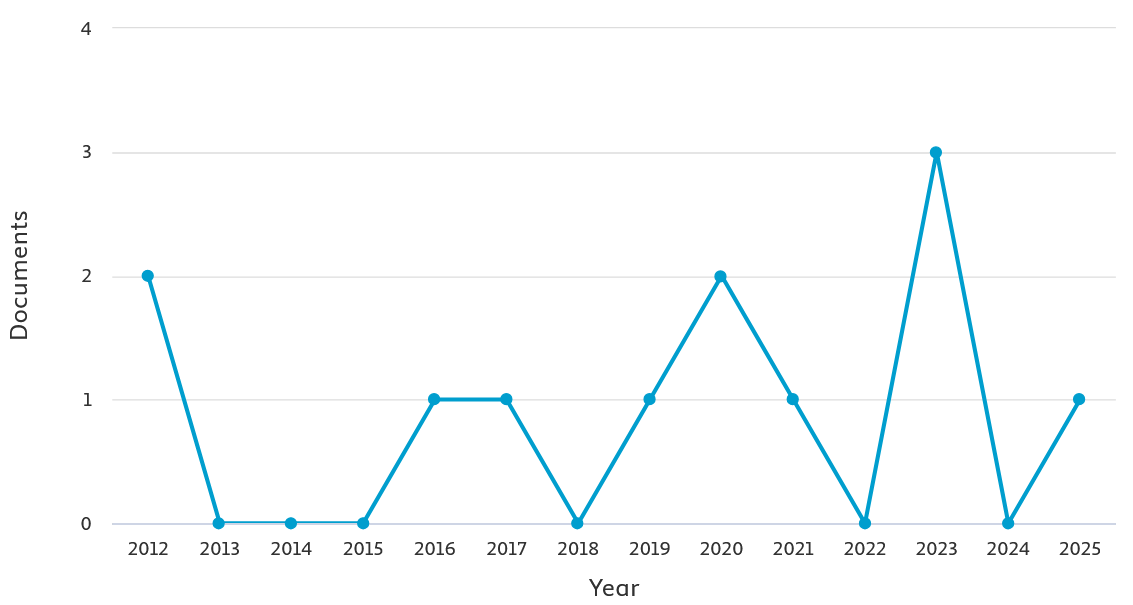
Figure . Documents per year. Source: Scopus.
Beyond the visible oscillation, the graph reveals the absence of a coherent evolutionary trajectory in the academic treatment of the binomial “generativity and talents”. The curve shows neither progressive growth nor cumulative stability: the peaks (2012, 2020, 2023) are episodic, isolated, without a visible spillover in the following years. The lack of continuity signals the thematic marginality in the scientific mainstream and the absence of consolidated research communities that deal with it systematically.
The data, apparently quantitative, has profound implications on the epistemological level: to date, there is no recognised field of study structured around generativity as an educational and transformative construct, nor its articulation with the concept of talent. The temporal inconsistency of production indicates a methodological and theoretical gap, which justifies the necessity and the urgency of a work of critical systematisation. Rather than measuring the “when” it was written, the graph reveals the emptiness of a pedagogical narrative that still struggles to assert itself and take root in educational planning and empirical research.
3.2. Research geography
The following graph shows the geographical distribution of the authors present in the selected corpus (Figure 2), not to quantify the origin of the contributions, but to reflect on the epistemological geographies implicit in the diffusion of this field of research.
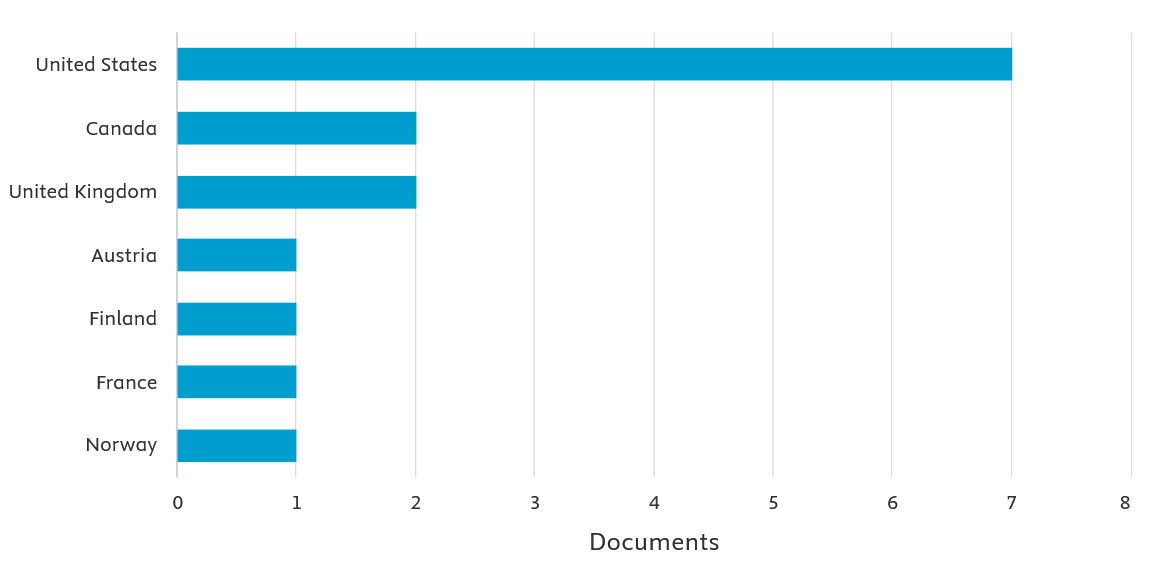
Figure . Documents by country or region. Source: Scopus.
An evident numerical predominance of the United States emerges, and an Anglo-American epistemic hegemony conditions the very definition of the concepts analysed. Beyond the surface of the data, the graph signals a lack of theoretical and cultural pluralism: the absence of contributions from countries in southern Europe, Asia, Africa, or Latin America reflects a field that is still geographically partial and unbalanced. This implies that generativity, and even more so generative talent, risk being conceptualised within implicit cultural models, linked to neoliberal, individualist or Anglo-Saxon matrices.
Although quantitatively describable, this geographical asymmetry is a pedagogical and political problem: what is not represented risks not being considered. The result is an urgent need for conceptual decolonisation and openness to situated knowledge, capable of enriching the international discourse with educational perspectives from alternative and non-hegemonic contexts.
3.3. Disciplinary distribution of literature
The survey of the main scientific fields involved (Figure 3) allows us to question the transversality of the theme and which disciplines today hold epistemic authority in the conceptualisation of generativity and talent.
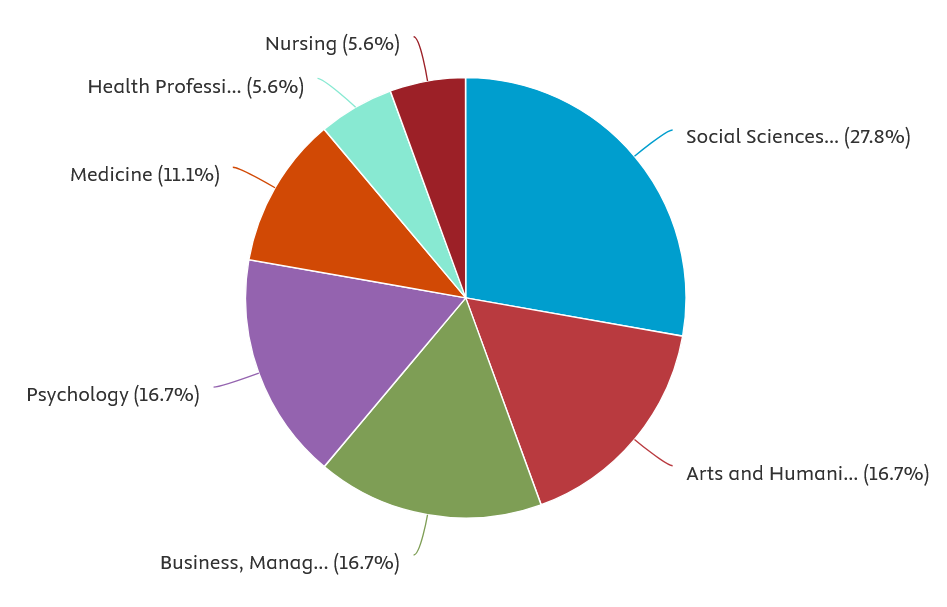
Figure . Documents by subject areas. Source: Scopus.
The most relevant fact is the absence of an explicit educational domain. Despite the apparent multidisciplinary variety, the distribution highlights a thematic presence in social sciences, psychology, management, and humanities, with a non-negligible presence in the medical and nursing fields. However, pedagogy, understood as an autonomous science, does not appear to be recognised. This disciplinary silence produces a disconnect between the transformative potential of the concepts analysed and their operation in training contexts.
In other words, generativity is discussed, studied and problematised in disciplines that do not have training as their primary goal. Talent continues to be treated as an individual attribute rather than as an educational construct to be intentionally designed and cultivated. It is a fragmentation that reflects a structural weakness of the pedagogical discourse within the international scientific horizon and reinforces the urgency of theoretical and methodological re-positioning within the global academic debate.
4. Bibliometric mappings
4.1. The most cited documents
The analysis of the citations makes it possible to identify which contributions have exerted the most significant influence in the construction of the thematic field investigated. Table 1 shows the documents with the highest number of citations.
Document | Citations | Links |
Peet (2012) | 61 | 0 |
Cohendet (2021) | 33 | 0 |
Vötter (2019) | 24 | 0 |
Newton (2016) | 17 | 0 |
Nath (2017) | 11 | 0 |
Dowd (2012) | 7 | 0 |
Talukder (2023) | 3 | 0 |
Zinck (2020) | 2 | 0 |
Clements (2023) | 2 | 0 |
Blieszner (2020) | 1 | 0 |
Wisdom (2025) | 1 | 0 |
Myllylä (2023) | 0 | 0 |
Table . Most cited documents.
The reading of the tabular data shows a strong dependence on a few key contributions, with a bibliographic impact concentrated on a small circle of authors. No articulated citation networks or consolidated scientific communities emerge. More than half of the papers have fewer than five citations, indicating the topic’s considerable dispersion and marginality in the international academic panorama.
The frequent presence of references to studies in the organisational field (Peet, 2012) or innovation management (Cohendet, 2021) confirms the shift of the concept of generativity towards extra-educational contexts, to the detriment of its systematisation in a pedagogical key.
The scarce visibility of existing contributions suggests that generativity – and even more so generative talent – are not yet recognised as central thematic nuclei in international educational research, but remain confined to episodic and fragmentary reflections. This represents a critical issue, but also an opportunity: restoring to pedagogy the responsibility of reappropriating the concept, rereading it as a founding category of educational planning.
4.2. Viewing Citations with VOSviewer
The bibliometric map (Figure 4), generated using the VOSviewer software, shows the spatial distribution of the documents in the corpus based on the number of citations received. The size of the spheres indicates the relative citation weight of each paper: the larger the sphere, the greater the impact of the article in the corpus. The colours follow a time scale (from blue to yellow), where blue represents the oldest publications and the most recent ones are yellow. The distance between nodes does not necessarily reflect thematic affinities or co-citations; only spatial positioning is generated based on the distribution algorithm.
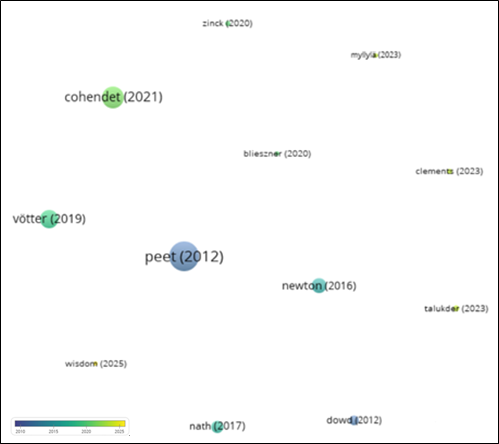
Figure . Most cited documents. Source: VOSviewer.
Peet (2012) occupies a central position on the map, dominating the number of citations. Although located in more peripheral areas, other works, such as those of Cohendet et al. (2021) and Vötter and Schnell (2019), are visible in size and relevance. However, the distribution of nodes shows poor connectivity: the documents appear isolated, without co-citation ties or mutual influences. The result is the absence of a shared theoretical core and a stable disciplinary dialogue.
The chromatic segmentation also confirms this fragmentation: there is no linear progression, nor a process of thematic consolidation. The most recent contributions do not seem to have activated cumulative dynamics or gained centrality in the field.
From a pedagogical point of view, the map suggests, more by absence than by evidence, the lack of a shared language and a common disciplinary lexicon. The different approaches respond to autonomous theoretical demands, inserting themselves into fragmentary, sometimes divergent traditions.
The invitation that emerges from this is clear: it is necessary to generate connections, build a camp, and activate a transdisciplinary epistemic community capable of recognising in generativity not only a descriptive quality but also a planning category of education.
4.3. Most cited authors
A further level of bibliometric analysis concerns identifying the authors who have obtained the highest number of citations in the corpus analysed. Table 2 shows the 25 most cited authors, each of whom has signed only one contribution, confirming the fragmentary nature of the field.
Author | Documents | Citations | TLS |
Peet, Melissa | 1 | 61 | 0 |
Cohendet, Patrick | 1 | 33 | 0 |
Mehouachi, Chahira | 1 | 33 | 0 |
Simon, Laurent | 1 | 33 | 0 |
Schnell, Tatjana | 1 | 24 | 0 |
Vötter, Bernadette | 1 | 24 | 0 |
Jones, Brady K. | 1 | 17 | 0 |
Newton, Nicky J. | 1 | 17 | 0 |
Nath, Vandana | 1 | 11 | 0 |
Dowd, James J. | 1 | 7 | 0 |
Talukder, Md Farid | 1 | 3 | 0 |
Wang, Haibo | 1 | 3 | 0 |
Clements, Dan | 1 | 2 | 0 |
Harris, Kerry | 1 | 2 | 0 |
Morgan, Kevin | 1 | 2 | 0 |
Neel, Joanna | 1 | 2 | 0 |
Zinck, Kirk | 1 | 2 | 0 |
Blieszner, Rosemary | 1 | 1 | 0 |
Domsky, Sarah | 1 | 1 | 0 |
Greene, Jacob | 1 | 1 | 0 |
Heiser, Deborah | 1 | 1 | 0 |
Morrow, Cynthia Drake | 1 | 1 | 0 |
Stone, Samantha | 1 | 1 | 0 |
Wisdom, Jennifer P. | 1 | 1 | 0 |
Myllylä, Mari | 1 | 0 | 0 |
Tolonen, Jonna | 1 | 0 | 0 |
The most relevant fact is that, except for very few cases, the authors do not present a continuity of publications on the subject nor constitute stable research nuclei. Individual works in isolation, and each author highlights an absence of consolidated strands, schools of thought or cohesive theoretical trajectories. Furthermore, the absence of positive Total Link Strength (TLS) for all authors indicates that, despite cited contributions, scholars lack bibliographic relational networks.
This fact reinforces the perception that a dispersed field is still emerging. It suggests the need to build a transdisciplinary scientific community that can take charge of generativity’s theoretical and formative structuring as a foundational pedagogical concept, without this work of connection between authors, the theme risks remaining devoid of disciplinary recognition and transformative repercussions in educational contexts.
4.4. Map of the most cited authors
The visualisation below, created with VOSviewer, gives a graphic representation of the spatial distribution of the authors present in the bibliographic corpus, based on the year of publication of their contributions. The colour of the nodes varies along a time scale (from purple to yellow), where the colder shades indicate publications prior to 2018 and the warmer ones the most recent works. The size of the nodes reflects, as per convention, the relevance or density of occurrences in the analysed set (Figure 5).
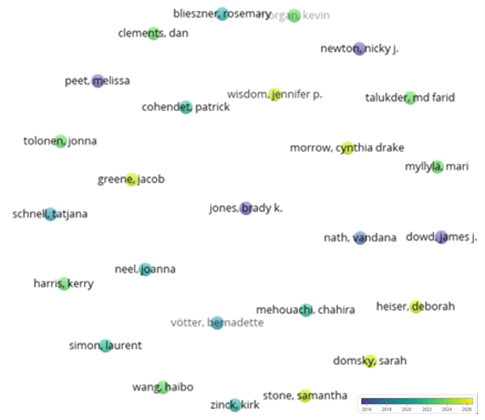
Figure . Most cited authors. Source: VOSviewer.
Beyond the demographic and geographical variety of the authors, the map gives a fragmented picture: the nodes appear dispersed, isolated, and devoid of connections of co-citation or scientific collaboration. This configuration confirms and deepens what has emerged: the “Generativity and Talents” field is not yet structured around a cohesive research network. It presents a disjointed set of individual contributions, matured along autonomous and often non-communicating disciplinary trajectories.
From an epistemological point of view, the absence of links between scholars suggests that there is no community of intentional research. Neither schools, nor currents of thought, nor shared theoretical articulations emerge. On the contrary, it is a heterogeneous, dispersed, potentially fertile aggregate, but still waiting for a shared structural system. Building bridges between these contributions is a priority for those who want to relaunch the discourse on generativity in an educational key, building dialogic links between authors, institutions and scientific cultures.
4.5. Co-authorship and connections between authors
In addition to the distribution of individual citations, bibliometric analysis allows us to investigate the relational network between authors, measuring the density and intensity of scientific collaborations (Table 3).
Author | Documents | Citations | TLS |
Peet, Melissa | 1 | 61 | 0 |
Cohendet, Patrick; Mehouachi, Chahira; Simon, Laurent | 1 | 33 | 2 |
Schnell, Tatjana; Vötter, Bernadette | 1 | 24 | 1 |
Jones, Brady K.; Newton, Nicky J. | 1 | 17 | 1 |
Nath, Vandana | 1 | 11 | 0 |
Dowd, James J. | 1 | 7 | 0 |
Talukder, Md Farid; Wang, Haibo | 1 | 3 | 1 |
Clements, Dan; Harris, Kerry; Morgan, Kevin | 1 | 2 | 2 |
Neel, Joanna; Zinck, Kirk | 1 | 2 | 1 |
Blieszner, Rosemary | 1 | 1 | 0 |
Domsky, Sarah; Greene, Jacob; Heiser, Deborah; Morrow, Cynthia Drake; Stone, Samantha; Wisdom, Jennifer P. | 1 | 1 | 5 |
Myllylä, Mari; Tolonen, Jonna | 1 | 0 | 1 |
Table . Co-authorship in order of citation.
The data collected shows that only very few authors share publications with other colleagues within the corpus. The only cases with a Total Link Strength (TLS) value of 2 or higher are those of Cohendet, Mehouachi and Simon (33 citations each, TLS 2), and Clements, Harris and Morgan (2 citations each, TLS 2). All the other authors, although among the most cited (such as Peet or Vötter), are isolated on the level of co-authorship. Even cases with TLS equal to 1 represent weak or sporadic connections, proving the lack, to date, of formalised and persistent research groups that systematically deal with generativity and talents. Collaborations seem occasional, bilateral, and not part of structured or transnational project frameworks. The field is fragmented on a theoretical, relational and organisational level.
To develop generative pedagogical thinking, it is strategic to activate alliances between research centres, promote stable co-authorships and encourage the construction of shared scientific writing networks. By its nature, generativity feeds on epistemic cooperation and common planning: bibliometrics gives back what has been written and what is still missing to make the theme truly fertile in an educational key.
4.5. Co-authorship strength: Total Link Strength (TLS)
The Total Link Strength (TLS) survey allows us to assess the presence of collaborations between authors and, above all, their intensity. The following excerpt highlights the authors with the highest TLS:
- Domsky, Greene, Heiser, Morrow, Stone, Wisdom: TLS = 5
- Cohendet, Mehouachi, Simon: TLS = 2
- Clements, Harris, Morgan: TLS = 2
All the others have TLS of 1 or 0, indicating that, in the corpus analysed, there are only very few high-density co-authorial micro-networks, while most collaborations are isolated or weak. In particular, the group formed by Domsky et al. represents one of the rare exceptions of repeated and cohesive collaboration. However, these micro-clusters remain confined within specific contributions, without being structured in theoretical laboratories or thematic research consortia. No highly cohesive scientific communities or central nodes capable of agglutinating several authors or currents emerge. This further strengthens the hypothesis that the theme of generativity is still dispersed and lacks a shared epistemic governance.
The TLS indicator, therefore, confirms what has already been observed: although there are signs of cooperation, there is a lack of a solid and recognisable collaborative architecture. To activate generative dynamics in the complete sense of the term, one cannot limit oneself to producing content. However, it is essential to generate stable spaces of design co-authorship, from which shared theoretical models, methodological continuities, and converging training languages can emerge.
4.6. Co-authorship, mapping and active connections
The two maps in Figure 6 and Figure 7 offer a comparative visualisation of co-authorship: the first includes the set of 26 authors, highlighting the general dispersion and disconnection; the second isolates the only six authors connected by collaborative relationships.
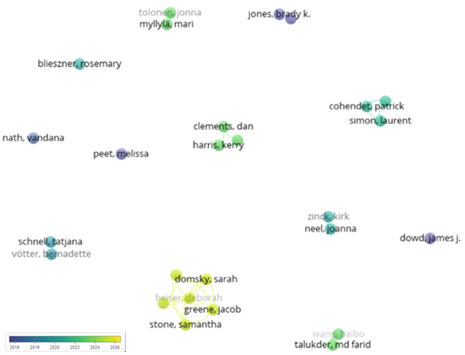
Figure . Co-authorship between all authors and among the most connected authors (panel A).
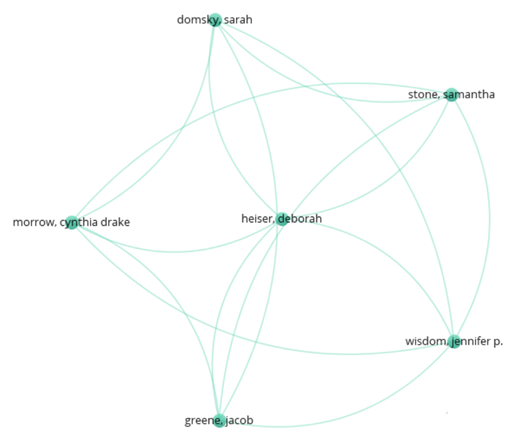
Figure . Co-authorship between all authors and among the most connected authors (panel B).
The first image confirms the fragmentation observed in the previous sections: the nodes, although spatially close, are isolated, without strong or recurrent interconnections. Only six authors (Domsky, Heiser, Greene, Stone, Morrow, Wisdom) show a stable co-authorship, represented in the second map, which appears intertwined in a coherent network.
This micro-grid represents an exception in the general panorama, resulting from a more structured collaborative experience than the norm, but limited to a small group, a clear sign of a poor ability of these connections to generate systemic impacts.
In pedagogical and strategic terms, this scenario invites us to overcome authorial enclaves and to promote conditions of collective writing, thematic epistemic networks and transdisciplinary exchanges. A culture of generativity in research cannot be separated from a generative relational infrastructure, capable of supporting converging visions and common design horizons. The challenge is bibliometric, political and cultural: to build both generative and generative communities.
4.7. Keywords and semantic co-occurrences
Keyword mapping is essential for interrogating the explicit contents of scientific production, its disciplinary subtexts, and implicit conceptual trajectories. Out of 108 keywords detected within the corpus, Table 4 presents a subset consisting exclusively of words with a minimum of two occurrences. Therefore, these eight keywords exceed this minimum threshold and have been selected to ensure interpretative consistency in the co-occurrence phenomena.
Keyword | Occurrences | TLS |
Generativity | 5 | 57 |
Human | 4 | 75 |
Article | 3 | 50 |
Humans | 3 | 65 |
Mentor | 2 | 40 |
Mentoring | 2 | 40 |
Midlife | 2 | 29 |
Psychology | 2 | 48 |
Table . Keywords sorted by frequency of occurrence.
Table 5, on the other hand, offers a different analytical angle, presenting all the keywords that, out of a total of 108, have recorded a Total Link Strength (TLS) value equal to or greater than 25. This filter returns 29 terms, partly overlapping the previous table, but highlights those words capable of activating broader and more relevant semantic connections within the bibliographic network.
Keyword | Occurrences | TLS |
Human | 4 | 75 |
Humans | 3 | 65 |
Generativity | 5 | 57 |
Article | 3 | 50 |
Psychology | 2 | 48 |
Mentor | 2 | 40 |
Mentoring | 2 | 40 |
Midlife | 2 | 29 |
African American | 1 | 25 |
African Americans | 1 | 25 |
Behavior | 1 | 25 |
Caucasian | 1 | 25 |
Community Involvement | 1 | 25 |
Community Participation | 1 | 25 |
Demography | 1 | 25 |
European Continental Ancestry Group | 1 | 25 |
Female | 1 | 25 |
Intention | 1 | 25 |
Legacy | 1 | 25 |
Longitudinal Studies | 1 | 25 |
Longitudinal Study | 1 | 25 |
Male | 1 | 25 |
Middle Aged | 1 | 25 |
Multivariate Analysis | 1 | 25 |
Narcissism | 1 | 25 |
Personal Construct Theory | 1 | 25 |
Questionnaire | 1 | 25 |
Race Differences | 1 | 25 |
Surveys And Questionnaires | 1 | 25 |
Table . Keywords sorted by TLS.
The two maps below (Figure 8 and Figure 9) help graphically visualise the relationship between keywords. The first (Figure 8) represents the totality of the 108 keywords.
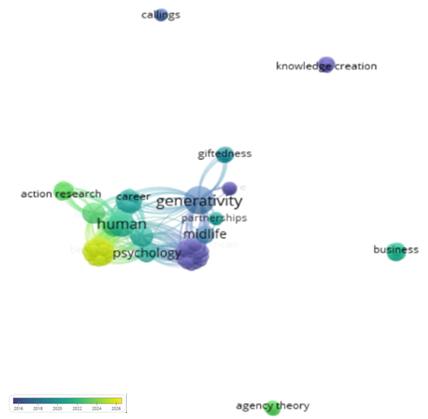
Figure . Map of co-occurrences among the 108 keywords. Source: VOSviewer.
The second (Figure 9) narrows the focus to the 82 words with at least one significant link with others, excluding the remaining 26 that are isolated and lack semantic connectivity.
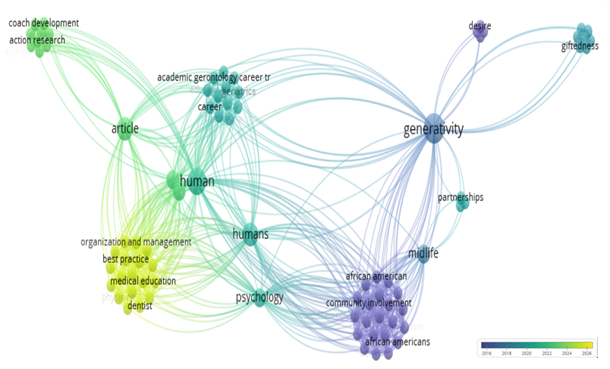
Figure . Map of the 82 connected keywords. Source: VOSviewer.
The cross-reading of the two visualisations returns a semantic topography marked by evident asymmetries: some keywords (generativity, human, psychology) act as poles of attraction within the graph, while many other concepts remain marginal or poorly integrated.
The presence of micro-clusters around terms such as “community involvement”, “legacy”, “narcissism” or “questionnaire” signals epistemological fragmentation and the absence of a shared educational vocabulary.
Semantic analysis confirms a dispersed panorama: only a work of conceptual clarity will be able to found interconnected and generative pedagogical research.
4.8. Editorial sources
The analysis of the editorial sources reiterates the absence of disciplinary direction and the fragmentation of the publication venues. The contributions are distributed in 12 journals (Table 6), many share neither a common language nor a precise epistemological positioning concerning the generativity-talent binomial. Rather than a fruitful plurality, an uncoordinated dispersion is outlined, which prevents the sedimentation of a scientific community around specialised journals or thematic columns.
Source | Documents | Citations | TLS |
Journal of Knowledge Management | 1 | 61 | 0 |
Industry and Innovation | 1 | 33 | 2 |
Frontiers in Psychology | 1 | 24 | 4 |
Developmental Psychology | 1 | 17 | 4 |
International Journal for Educational and Vocational Guidance | 1 | 11 | 3 |
Journal of Aging Studies | 1 | 7 | 2 |
International Journal of Manpower | 1 | 3 | 0 |
Adultspan Journal | 1 | 2 | 5 |
Sport, Education and Society | 1 | 2 | 0 |
Clinical Teacher | 1 | 1 | 0 |
Gerontology and Geriatrics Education | 1 | 1 | 0 |
Figurations of Peripheries Through Arts and Visual Studies: Peripheries in Parallax | 1 | 0 | 0 |
Significantly, only half of the sources have relevant connections with the rest of the corpus (according to the TLS parameter), while the others remain disconnected. The following map visually shows this fracture: only six establish effective semantic connections (Figure 10).
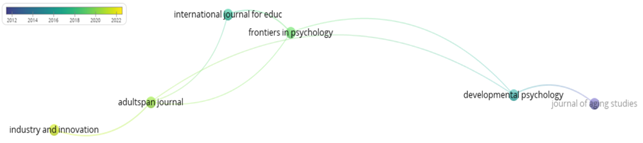
Figure . Map of connected sources. Source: VOSviewer.
The exclusion of half of the sources from the co-occurrence network signals a structural weakness in the circulation of knowledge and the absence of a shared “editorial ecology”. The connected sources aggregate around similar themes without generating a critical mass sufficient to guide future production. In other words, the intersection between generativity and talent has not yet found a stable and recognised publishing habitat.
It is therefore necessary to think in infrastructural terms, since individual articles or authors are not enough, but editorial alliances, thematic columns, and projects shared between similar journals are needed. Only through constructing an intentional editorial ecosystem will it be possible to give coherence and visibility to this emerging field.
5. Critical review of the international literature on Generativity and Talents
5.1. State of the art and theoretical orientations
The notion of generativity, introduced initially by Erik H. Erikson (1950; 1982) as the seventh stage of psychosocial development, is configured as a tension towards the care of future generations and the construction of a symbolic and concrete legacy. In subsequent international literature, particularly with the works of McAdams (2001) and McAdams & de St. Aubin (1992), generativity is redefined as a narrative and motivational disposition, closely connected to personal identity, planning and a sense of social responsibility. However, despite its intrinsic connection with the production of educational and social value, the literature analysed shows a marked epistemological heterogeneity, accompanied by gaps in the pedagogical level.
Within the bibliographic corpus identified on Scopus, the concept of generativity is frequently treated in adulthood and intergenerational accompaniment processes (Blieszner, 2020), leadership transitions in organisational contexts (Peet, 2012), and educational partnerships in training (Zinck & Neel, 2020). In these studies, generativity is mainly defined as a psychological and relational construct, sometimes associated with dynamics of empowerment and transmission of tacit knowledge, but rarely thematised as an educational skill that can be cultivated in school or academic contexts. Therefore, a partial invisibility of the pedagogical paradigm is highlighted, which, if present, is implicitly absorbed by theoretical frameworks of an andragogical or organisational nature.
There is a lack of a systematic conceptualisation of generativity as an intentional educational outcome, that is, as a programmable and assessable objective of educational paths. Furthermore, the literature analysed presents an almost total void regarding talent, even though the latter is implicitly evoked in the dimensions of generative creativity, planning, and transformative leadership.
5.2. Methodological arrangements and research guidelines
From a methodological point of view, the contributions collected mainly use qualitative exploratory approaches, with an apparent prevalence of case studies, semi-structured interviews and participant observations. These tools have proved helpful in bringing out experiences, identity narratives and relational configurations, but they are insufficient from the perspective of a systemic and comparative literature analysis.
The absence of mapping reviews, bibliometric analyses, or mixed methods approaches highlights the urgency of a reconnaissance work aimed at mapping, categorising and problematising existing scientific production. In this context, the proposal of a systemic study of international literature is justified and capable of bridging the gap between the abundance of fragmentary contributions and the need for an integrated and pedagogically based theoretical framework.
5.3. Heuristic spaces and implications for education
From the educational point of view, generativity can be reinterpreted in the light of classic pedagogical categories such as integral formation of the person, education for active citizenship, enhancement of the intergenerational dimension and promotion of the common good (Nussbaum, 2011). However, the corpus examined does not propose explicit pedagogical models or operational hypotheses on educational devices capable of developing generativity in children, adolescents or young adults.
None of the studies collected, for example, thematises the intersection between generativity and school curriculum, nor explores the possibility of enhancing generative talents through proactive learning environments, active methodologies (Flipped Learning, Service Learning, Laboratory Teaching) or narrative devices (autobiography, e-portfolios, digital narratives). This constitutes a significant blind spot, which opens an interesting line of research in the pedagogical field: how to design educational contexts and practices oriented towards the intentional formation of generativity?
A further lack is the absence of qualitatively evaluative indicators (values, attitudes, observable behaviours), and quantitative (scoring, rubrics, self-assessment). These gaps make the concept operationally fragile, while acknowledging its symbolic and social richness.
6. Conclusions and perspectives
Far from being a territory already traced, the “Generativity and Talents” field is configured as a landscape under construction: littered with intuitions, crossed by conceptual tensions, still devoid of shared grammar. The analysis returns to a disaggregated horizon, only weakly rooted in the pedagogical tradition, where the word generativity is evoked, but rarely embodied, and where talent is often confined to static representations, more inherited than transformed.
The lack of a common educational lexicon, the dispersion of publishing venues, the rarefaction of collaborations between authors and the weakness of thematic networks give back the image of a knowledge that is still nascent and not recognised as a structured field nor supported by cohesive scientific communities. However, it is precisely in this epistemic fragility that a possibility lurks: the chance to give life to a pedagogical framework capable of welcoming generativity not as an occasional attribute, but as a formative, intentional, shared principle.
A vision that intertwines personal vocation and collective responsibility, desire for the future and transformative practice of learning. Some emerging perspectives are moving in this direction (Coppi, 2020; 2023; van der Sandt & Coppi, 2021), which enhance education as a generative space, based on trust, reciprocity and the possibility of re-signifying the experience. What emerges strongly is the need to restore centrality to the pedagogical paradigm, currently marginalised by psychological or managerial approaches. If embraced as an intentional learning outcome, generativity allows us to rethink talents not as resources to be selected, but as opportunities to be cultivated in every educational context. From this perspective, quantitative data find their meaning, as they do not represent descriptive snapshots, but rather traces that prompt a process of theoretical and design recomposition, capable of translating into operational models for contemporary schools and education.
It thus becomes urgent to imagine a research trajectory that is not limited to mapping what already exists but knows how to become a generative gesture: capable of connecting dispersed knowledge, giving shape to coherent educational models, and developing evaluation tools that make visible what is generated in processes, relationships, and formative intentions (Rivoltella, 2001). We need to overcome the idea of talent as an exception and recognise it as a movement, a relationship, and a possibility that can be cultivated (Sibilio & Aiello, 2015) just as generativity can no longer be only evoked in the margins but placed at the centre of a pedagogical thought that wishes to affect reality and contribute to the construction of a humanity capable of the future.
The intrinsic limit of this work must be recognised with equal clarity: the adoption of a single database, the use of a circumscribed string and the absence of disciplinary filters could have excluded significant contributions published under other names or in similar frames. Furthermore, the bibliometric perspective, although helpful in tracing connections and discontinuities, is insufficient to restore their dense complexity. In the following developments, it will therefore be necessary to integrate hermeneutical readings, case studies, ethnographic investigations, and textual analyses that can bring the human and narrative dimension of educational knowledge back to the forefront.
This study does not close as a conclusion, but opens as a passage: a fertile crossing, a gap that leads beyond the traced horizon. It does not offer definitive answers, but invites us to pause in complexity, to inhabit research as a generative act, as a practice of intellectual care and shared transformation.
In the educational field, thinking is not just transmitting: it generates meaning, ignites desire, and cultivates the expectation of what is not yet but can come to light.
Perhaps it is precisely in this tension between incompleteness and potential that the deepest vocation of pedagogy lurks: not to train to adapt, but to liberate. Ultimately, education is an act of radical trust in humans: a gesture that becomes the future, which calls us to be responsible for generating new possibilities for the world together.
References
Blieszner, R. (2020). Enacting generativity, sustaining gerontology education. Gerontology and Geriatrics Education, 41(4), 486–490. https://doi.org/10.1080/02701960.2020.1717833
Clements, D., Morgan, K., & Harris, K. (2023). Investigating the use of Appreciative Inquiry as a process for coach development within a National Governing Body talent development programme. Sport, Education and Society, 28(8), 972–989. https://doi.org/10.1080/13573322.2022.2086113
Cohendet, P., Simon, L., & Mehouachi, C. (2021). From business ecosystems to ecosystems of innovation: The case of the video game industry in Montréal. Industry and Innovation, 28(8), 1046–1076. https://doi.org/10.1080/13662716.2020.1793737
Coppi, A. (2020). Eudemonia and lifelong learning for global citizenship education. Formazione & insegnamento, 18(1 Tome I), 36–45. https://doi.org/10.7346/-fei-XVIII-01-20_04
Coppi, A. (2023). Dare fiducia: Dialogo e cura nei contesti educativi. Studi sulla Formazione, 26(1), 1–11. https://doi.org/10.36253/ssf-14450
Dowd, J. J. (2012). Aging and the course of desire. Journal of Aging Studies, 26(3), 285–295. https://doi.org/10.1016/j.jaging.2012.01.004
Erikson, E. H. (1950). Childhood and society. W. W. Norton.
Erikson, E. H. (1982). The life cycle completed. W. W. Norton.
Mannese, E. (2023). Manuale di pedagogia generativa e sistema-mondo: Epistemologie e comunità pensanti per l’homo generativus. Pensa MultiMedia.
Mannese, E., Lombardi, M. G., & Marigliano, R. (2023). Il paradigma della pedagogia generativa tra orientamento e sviluppo dell’empowerment individuale. Lifelong, Lifewide Learning, 20(43), 101–110. https://doi.org/10.19241/lll.v20i43.791
Margiotta, U. (2018). La formazione dei talenti: Tutti i bambini sono un dono, il talento non è un dono. FrancoAngeli.
McAdams, D. P. (2001). The psychology of life stories. Review of General Psychology, 5(2), 100–122. https://doi.org/10.1037/1089-2680.5.2.100
McAdams, D. P., & de St. Aubin, E. (1992). A theory of generativity and its assessment through self-report, behavioral acts, and narrative themes in autobiography. Journal of Personality and Social Psychology, 62(6), 1003–1015. https://doi.org/10.1037/0022-3514.62.6.1003
Myllylä, M., & Tolonen, J. (2023). Formation of artistic identity: Applying themes of narrative identity development in two artists’ life stories. In M. Loukola, M. Mäkiranta, & J. Tolonen (Eds.), Figurations of peripheries through arts and visual studies: Peripheries in parallax (pp. 96–109). Routledge. https://doi.org/10.4324/9781003348269-9
Nath, V. (2017). Calling orientations of junior doctors and medical interns in India: Cultural, occupational and relational perspectives. International Journal for Educational and Vocational Guidance, 17(2), 143–163. https://doi.org/10.1007/s10775-016-9321-2
Newton, N. J., & Jones, B. K. (2016). Passing on: Personal attributes associated with midlife expressions of intended legacies. Developmental Psychology, 52(2), 341–353. https://doi.org/10.1037/a0039905
Nussbaum, M. (2011). Creating capabilities: The Human Development Approach. Harvard University Press.
Peet, M. (2012). Leadership transitions, tacit knowledge sharing and organisational generativity. Journal of Knowledge Management, 16(1), 45–60. https://doi.org/10.1108/13673271211198931
Rivoltella, P. C. (2001). Media education: Modelli, esperienze, profilo disciplinare. Carocci.
Sibilio, M., & Aiello, P. (Eds.). (2015). Formazione e ricerca per una didattica inclusiva. FrancoAngeli.
Talukder, M. F., & Wang, H. (2023). Analysing the impact of stock options on talent retention and knowledge product generativity at knowledge intensive firms. International Journal of Manpower, 44(5), 810–824. https://doi.org/10.1108/IJM-09-2022-0411
van der Sandt, J., & Coppi, A. (2021). Community music: Perspectives on a new model for music education and social change in Italy. Musica Docta, 11, 23–39. https://doi.org/10.6092/issn.2039-9715/13971
Vötter, B., & Schnell, T. (2019). Bringing giftedness to bear: Generativity, meaningfulness, and self-control as resources for a happy life among gifted adults. Frontiers in Psychology, 10, Article 1972. https://doi.org/10.3389/fpsyg.2019.01972
Wisdom, J. P., Morrow, C. D., Greene, J., Stone, S., Domsky, S., & Heiser, D. (2025). Perspectives of mentors on mentoring: A scoping review of benefits and challenges. Clinical Teacher, 22(3), Article e70101. https://doi.org/10.1111/tct.70101
Zinck, K., & Neel, J. (2020). A study of generative partnership. Adultspan Journal, 19(2), 100–111. https://doi.org/10.1002/adsp.12105